Showing posts with label Historical. Show all posts

Friday, February 13

The Iroquois Theater fire


A fire during a holiday matinee kills hundreds and leads to tougher safety standards nationwide.

By the time firefighters fought their way inside the Iroquois Theater after an arc light ignited a strip of paint-saturated muslin on a drape, an eerie silence had fallen over the charred and darkened remains of the theater. (Photo courtesy Burke and Koretke)

Click the link above to watch a one minute video.

Saturday, November 29

our lady of the angels fire 95 students killed 50th anniversary -- chicagotribune.com


our lady of the angels fire 95 students killed 50th anniversary -- chicagotribune.com
On Dec. 1, 1958, a fire consumed Our Lady of the Angels grade school on the West Side of Chicago, killing 92 children and three nuns.

A wire story from that day captured a fragment of the desperation:

"Max Stachura stood outside the burning building, begging his little boy, Mark, 9, to jump into his arms. Children were falling all about the father and he caught or stopped the fall of 12 of them. But little Mark was too frightened or he didn't understand his father. Mark didn't jump."

Fifty years later, Mark's mother has the day in crisp focus, and adds a missing detail.

As Mark stood at that second-floor window, fire to his back, he held a small statue in his hand and waved it proudly through the black smoke, hoping his father would notice. Mark had won the statue that day — a figure of an infant Jesus — for being first to answer a quiz question.

"I guess he was just so proud of that prize," said Mary Stachura, now in a retirement home in Bartlett. "I don't think he really understood what was happening."

Few of the children trapped in the school could have grasped the enormity of the danger they faced, and few of the panicky adults on the ground — parents and neighbors and firefighters — had time to reflect. They acted, grabbing ladders of all lengths from garages, reaching through broken windows to haul small, waterlogged bodies from the flames.

Max Stachura watched as other children pushed his son back, away from the window and into the flames. The boy was later identified by a homework sheet crumpled in his pocket.

Max rarely spoke of that day. He died suddenly of a heart attack at 52.

"He was much too young," said Mary, now 85. "That fire. It changed everything."

The fire at Our Lady of the Angels remains one of the worst tragedies in Chicago's history, a ghastly few hours on a cold, sunny afternoon that shattered families and knocked a hopeful, growing community forever off its path.

The cause of the fire was never officially determined, and no one was held accountable. Some parents who lost a child--or children-- found ways to blame each other and wound up divorced. Others sold their tidy two flats and moved away, hastening the flight of the middle class from the city's West Side.

"It seems as though people just couldn't get far enough away," said Jill Grannan, a curator at the Chicago History Museum. "That school and that parish is one that had a lot of people. It had a growing population. There was such a boom, and then people really just had to leave.

"I don't think the community ever really came back."

Few in the neighborhood now would recall the blaze. But for parents and firefighters, journalists and now-grown schoolchildren, the memories remain etched in intricate detail.

Steve Lasker, then a photographer for The Chicago American newspaper, was driving along Grand Avenue, heading to his newsroom after an assignment in Elmwood Park. He heard a call come over a radio tuned to the police frequency: "They're jumping out the windows!"

"But I didn't know where it was," Lasker said. A fire engine cut in front of him and he quickly turned to follow. He parked on Iowa Street and headed toward the smoke, stopping abruptly when he saw the school on Avers Avenue in flames.

"I froze for a few seconds, or maybe it was minutes, I don't know, I couldn't tell," said Lasker, now 78. "Oh my God, there's still kids in there. Mayhem was going on and they started pulling kids out of there left and right."

From atop a fire truck, Lasker shot one of the most iconic photos of the day. It showed a helmeted firefighter, his face drawn in sorrow, carrying the soaking wet, lifeless body of 10-year-old John Jajkowski Jr. from the building.

Just 28 and the father of a 6-month-old girl, Lasker felt his stomach churn as he watched the rescue through the lens of his camera. The cold wind froze tracks of tears on his face. Though many photos were published, 20 years would pass before he would voluntarily show them to anyone.

Click the title above to read the rest of the story.

Sunday, June 8

The Dupont Plaza Hotel Fire

The Dupont Plaza Hotel fire was a fire that occurred on the Hotel Dupont Plaza (now San Juan Marriott Resort & Stellaris Casino) on New Year's Eve, December 31, 1986.

The fire was initiated by three disgruntled employees of the hotel that were in the middle of a labor dispute with the owners of the hotel. In the end, the fire claimed 97 lives and caused 140 injuries.

This is considered to be the most catastrophic hotel fire in Puerto Rican history.
From the old 911! Series with William Shatner:

Part I


Part II


For more info about this fire, check out
http://www.iklimnet.com/hotelfires/case13.html
http://en.wikipedia.org/wiki/Dupont_Plaza_Hotel_arson
http://www.fire.nist.gov/bfrlpubs/fire87/art003.html
http://www.nfpa.org/itemDetail.asp?categoryID=446&itemID=18575&URL=Research%20&%20Reports/Fire%20investigations/Hotels/Motels/Dormitory&cookie%5Ftest=1

Wednesday, February 20

For Station survivors, painful memories


PROVIDENCE - Gina Russo’s head was seared down to the skull, her body pocked by third-degree burns, her future consumed by painful skin grafts and guilt over having survived The Station nightclub fire when her fiance had not.

“I remember people would come to visit, and then when everybody was gone, thinking, ‘How am I going to do this? Why was I kept alive?’ ” Russo said.

Five years ago tomorrow, fire tore through the club in West Warwick, killing 100 people and injuring more than twice that many. The blaze began when pyrotechnics used by the band Great White ignited flammable soundproofing foam that covered the walls and ceilings.

Survivors live with disfigurement, depression and steep medical bills, and victims’ relatives endure flashes of bitter anger and loneliness.

However, they also have found ways to cope.

James Gahan has set up scholarships for youth sports programs in the name of his son, Jimmy, one of those who died, and has worked for stricter fire codes.

Bonnie Hoisington still tears up when she hears “One Particular Harbour,” a Jimmy Buffett song that reminds her of her daughter, Abbie, but she finds comfort in her new grandchild, born to another daughter after Abbie died.

Russo says she is determined not to let the memory of that night and the loss of her fiance, Alfred Crisostomi, dominate her thoughts.

Russo was placed in a medically induced coma because she had third-degree burns on 40 percent of her body, and she didn’t wake up until 11 weeks after the fire. She remembers the pyrotechnics and seeing the ceiling melting, smoke, heads on fire. Crisostomi put his hand on her back and pushed her forward, yelling “Go!” and she never saw him again. He died from inhaling toxic fumes.

After she woke up, she needed help standing, bathing and tying her shoes. She has scars up and down her arms and wears an auburn-colored wig in public.

During her arduous rehabilitation, Russo drew motivation from the need to care for her young sons, and from her faith that Crisostomi would have prodded her to recover. Even so, as each anniversary awakens painful memories, her normally bright demeanor turns somber and her family knows that’s the time to give her space.

She and others feel let down by the justice system.

A grand jury indicted club owners Jeffrey and Michael Derderian and former Great White tour manager Daniel Biechele, though many victims believed members of the band and the local fire inspector also were culpable. All three reached plea deals, and Biechele and Michael Derderian were sent to prison in 2006.

Biechele is scheduled to be released on parole next month, and Derderian in 2009. Jeffrey Derderian was spared jail time and ordered to perform community service.

VH1 Classic and VH1 on Board to Televise 'VH1 Classic Presents: Aftermath: The Station Fire Five Years Later' Friday February 15, 3:09 pm ET
One-Hour Special Will Also Share Survivors' Stories on Easter Sunday, March 23 10:00 P.M.*

PROVIDENCE, R.I., Feb. 15 /PRNewswire/ -- VH1 Classic and VH1 will air "VH1 Classic Presents: AFTERMATH: The Station Fire Five Years Later" a one- hour special of concert highlights on Sunday, March 23, 2008 10:00 p.m.* from the upcoming Phoenix Rising! Musicians United to Benefit the Victims of the Station Nightclub Fire. John Rich (Big & Rich), Alabama's Randy Owen, Dierks Bentley, Kellie Pickler and Gretchen Wilson will be joining Aaron Lewis (Staind), Tesla, Twisted Sister, Kevin Max and Stryper featuring Tom Scholz and Gary Pihl of Boston and the just added, Winger among others.
For the rest of the article click the link "VH1".

For more info or to make a donation, check out http://www.stationfamilyfund.org/

Tuesday, September 11

The Station nightclub fire


The Station Nightclub Fire on the evening of Thursday, February 20, 2003, was the fourth-deadliest nightclub fire in U.S. history, killing 100 people and injuring more than 200. Ninety-six perished on the night of the fire, and four died later from their injuries at local hospitals. The Station, which regularly hosted glam metal and '80s rock bands, was a nightclub in West Warwick, Rhode Island.The fire started about 11:08 PM, just seconds into headlining band Great White's opening song "Desert Moon", when pyrotechnics set off by their tour manager, Daniel Biechele, lit flammable soundproofing foam behind the stage. The flames were first thought to be part of the act; only as the fire reached the ceiling and smoke began to billow did people realize it was uncontrolled. Only 20 seconds after the pyrotechnics ended, the band stopped playing, and lead singer, Jack Russell, remarked into the microphone, "Wow... this ain't good." In less than a minute, the entire stage was engulfed in flames. Although there were four possible exits, most people naturally headed for the door through which they entered. The ensuing stampede in the inferno led to a crush in the hallway leading to that main entrance, eventually blocking it completely and resulting in numerous deaths and injuries among the patrons and staff, who numbered somewhat more than 404, the highest of three conflicting official capacity limits. Of those in attendance, roughly one quarter died (either from burns or smoke inhalation), and half were injured. Among those who perished in the fire was Great White's lead guitarist, Ty Longley.

The pyrotechnics were gerbs, cylindrical devices intended to produce a controlled spray of sparks. Gerbs are labeled using two numbers: one for how far the sparks fly and one for how long the effect lasts. Biechele was fond of using 15 by 15's, which spray sparks 15 feet for 15 seconds. Three of that same caliber, at 45-degree angles, with the middle one pointing straight up, were the kind used that night. Gerbs are considered appropriate for indoor use before a nearby audience when proper precautions are observed.

An NIST investigation of the fire, using computer simulations and a mock-up of the stage area and dance floor, concluded that a sprinkler system would have successfully contained the fire enough to give everyone time to get out safely. However, due to its age (built in the late 1930s) and size (4,484 square feet (404 m²)), the Station was believed by many to be exempt from sprinkler system requirements. In actuality, it had undergone an occupancy change when it was converted from a restaurant to a nightclub. This change dissolved its exemption from the law, a fact that West Warwick fire inspectors never noticed. On the night in question, the Station was legally required to have a sprinkler system, but did not.

Also the blueprints show that the entryway to the nightclub had a ramp which blocked off a straight exitway through the door. When exiting the building, one would have to exit either right or left because the building was constructed to lead two entry ways with the handrail running parallel with the building.

The events that occurred during the fire were caught on videotape by cameraman Brian Butler for WPRI-TV of Providence and the beginning of it was released to national news stations. Later, the video would circulate via file sharing online. He was there, ironically, for a planned piece on nightclub safety being reported by Jeffrey Derderian, a WPRI news reporter who is also a part-owner of The Station. WPRI-TV would be cited for an ethics violation for having a reporter do a report concerning his own property. The report had been inspired by the Chicago nightclub stampede that had claimed 21 lives only four days earlier.

Beverly Hills Supper Club Fire

A historic look back at the Beverly Hills Supper club fire. Aprox 9 mins.

Our Lady of the Angels School Fire

A (homemade-student) video made of the OLA fire. 3:23

Monday, September 10

Bradford City Football Stadium Fire

The fire at Bradford City football ground on 11th May 1985.
The cause of the fire is thought to have been the accidental dropping of a match or a cigarette stubbed out in a polystyrene cup and the resulting fire was fuelled by rubbish underneath the wooden stand.
The antiquated stand at Valley Parade eventually claimed the lives of 56 supporters and about 265 were injured. It was the worst fire disaster in the history of British football history.

Monday, August 27

Histeria: Wheel of History

Powered by AOL Video
Nostradamus spins the Wheel of History and explores events such as the Great Chicago Fire as well as fulcrums, pulleys and screws...oh my!21:21

Saturday, August 25

The Great Chicago Fire of 1871--National Geographic Kids Magazine


The Great Chicago Fire of 1871--National Geographic Kids Magazine
The story of a young girl's escape from the blaze. Also from this site links to NFPA and the basic info on the Chicago fire:
Chicago in 1871 was already a big city, bustling with more than 334,000 residents. Its streets, sidewalks, and most of its buildings were made of wood. Hay and straw were inside every barn. To make the situation worse, people used candles and oil lamps.

Fires had been common that year because of the dry weather. The Chicago Fire Department was overworked and underequipped. On Saturday, October 7, firefighters began putting out a fire that wiped out four city blocks. It took them 16 hours. By Sunday evening the men were exhausted. Then around 8:45 p.m., a fire began in the barn of Patrick and Catherine O’Leary.

FROM THE BEGINNING, EVERYTHING WENT WRONG

Human error then made a bad situation worse. One firefighter later said, “From the beginning of that fatal fire, everything went wrong!” A watchman atop the courthouse saw smoke rising from the O’Leary barn, but he assumed it was coming from the previous fire. When he finally realized a new fire was blazing, he misjudged its location. His assistant sent a message to the fire stations, but he mistakenly directed horse-drawn fire wagons to a location about a mile from the burning barn. When the fire department finally reached the barn, its equipment was no match for the blaze. The new fire raged on.

More links:
Web of Memory http://www.chicagohistory.org/fire/
Did the Cow do it? http://www.thechicagofire.com/
Chicago Public Library http://www.chipublib.org/004chicago/disasters/great_fire.html

Tuesday, June 26

RAGING TAHOE FIRE'S ROOTS: 150 YEARS OF FOREST ABUSE / HISTORY OF MISMANAGEMENT: From Gold Rush logging to modern development


RAGING TAHOE FIRE'S ROOTS: 150 YEARS OF FOREST ABUSE / HISTORY OF MISMANAGEMENT: From Gold Rush logging to modern development

This article explains why todays forest fires are so much more destructive then the ones we fought 50 years ago. It is worth clicking the link above and reading the entire story.
The raging fire that is denuding hillsides and darkening the clear blue waters of Lake Tahoe is the final product of 150 years of mismanagement of the Sierra Nevada ecosystem, fire management experts said Monday.

From Gold Rush clear-cutters to modern home-builders, people have brought changes to the Tahoe basin that have fueled the intensity of the 2,500-acre Angora fire near the town of South Lake Tahoe. By Monday night, 178 homes had fallen casualty to the 2-day-old blaze, which was only 40 percent contained.

Ecologists and local residents said they saw such a disaster coming.

"It's the fire we've been anticipating for 20 years," said Patsy Miller, who owns a residence at Fallen Leaf Lake, about a mile from where the flames had spread by late Monday.

"People have interjected their homes into a system that has a natural tendency to burn very frequently, and where we have suppressed the frequency of those fires for so long, there's an ungodly amount of fuel there," Forest Service regional ecologist Hugh Safford said.

The immediate cause of the Angora fire was under investigation Monday. But the fire's beginnings can be traced all the way back to the Gold Rush and the Comstock-era mining boom.

"They clear-cut about two-thirds of the basin," said Shane Romsos, science and evaluation program manager for the Tahoe Regional Planning Agency.

Mixed-growth forests of fire-tolerant species like the self-pruning Jeffrey pine were replaced by uniform stands of dense white fir and undergrowth, which grew rapidly in the unusually wet years of the early 20th century.

Then came the vacation homes and ski areas. As development spread, land managers focused on fire suppression, allowing the fuel load to build every year.

Federal officials began to shift fire-management policies in the mid-1990s and in recent years have sought to clear away dense underbrush and thin trees in the forests around Tahoe and in the rest of the Sierra. U.S. Forest Service officials said those efforts probably saved at least 500 homes that otherwise could have been engulfed by the Angora fire.

But many forests are still vulnerable to catastrophic burns. This past winter had a notable shortage of snowfall, and Sunday brought ferocious winds that whipped the flames from treetop to treetop even in woodlands where some thinning had been done. Winds that died down Monday were expected to pick up tonight and Wednesday.

"Conditions were ripe for a fire like this," Romsos said.

Now, fire-stripped hillsides could lead to a surge of runoff, clouding Lake Tahoe.

Sunday, June 10

History with Fire in Its Eye: An Introduction to Fire in America, The Use of the Land, Nature Transformed


History with Fire in Its Eye: An Introduction to Fire in America, The Use of the Land, Nature Transformed, TeacherServe, National Humanities Center
An essay by Stephen Pyne that discusses the origin of the fire policy in the US.
For the 1880 census, Charles Sargent mapped forest fires. Fire was nearly everywhere, some places more vigorously than others. The amount of burning was, by today's standards, staggering. A developing nation, still primarily agricultural, the United States had a fire-flushed landscape not unlike those of Brazil and Indonesia in more recent decades. While lightning accounted for some ignition, and steam power (notably locomotives) for a growing fraction, the principal sources of fire were people—people burning for hunting, for traditional foraging, for landclearing, for clearing field fallow, for pasturage, for the ecological equivalent of housecleaning. And of course there was a significant amount of sheer fire littering. Where spark met large caches of combustibles (as around logged sites), horrific fires, implacable as hurricanes, broke out. The idea that one might abolish fire seemed quixotic, in fact, dangerous. Without fire most lands were uninhabitable. Free-burning fires came and went with the seasons, as unstoppable as the movement of the sun across the heavens. Right-thinking conservationists, as good Progressives, argued for government intervention to stop them.

Click the link above to read the entire essay.

Monday, May 28

1977 supper-club fire still haunts rescuers


The Columbus Dispatch : 1977 supper-club fire still haunts rescuers

Today is the 30th anniversary of the Beverly Hills Supper Club fire (which occured in Kentucky).
On May 28, 1977, as many as 2,800 guests and employees were in the club on a hilltop across the Ohio River from Cincinnati. An estimated 1,300 of those people sat at tiny tables jammed into the Cabaret Room, nearly triple the number of occupants the room could safely accommodate.

The building did not have an automatic sprinkler system, now regarded as a common fail-safe in public buildings and required in many areas.

Investigators later blamed the fire on problems with the aluminum wiring.

John Beatsch, now chief of Southgate Fire Department, was 21 and on the first firetruck to respond.

After arriving, he ran to the back, where firefighters were pulling people from the Cabaret Room. The overflow crowd had been wedged in. Tables and chairs had been set up in the aisles and along ramps to the stage.

"We could hear people calling for help. Firefighters were yelling, 'Move your arms.' They were piled up. It seemed the people on the bottom were alive. The people on top were overcome."

Firefighters also were frantically searching inside the building; they worked until nearly dawn pulling bodies out.

"There were plenty of signs that said exit, but they didn't lead directly to exits," said Greg Hirsch, a Southgate firefighter. "There was a long hallway and if you went all the way down, there was an exit. But there were dressing rooms and closets along the hallway. We found people inside those rooms. They got confused, couldn't see. They thought they found a door."

Gerald Sanford, now chief of Central Campbell County Fire District, had traded shifts with another firefighter and was working that night.

"Being in Vietnam, I thought that was the worst you could see," he said. "But even having that training, I wasn't prepared for 165 people dying."


Here are links to more information about this fire:
The Cincinnati Post- In depth report of all aspects of the fire. Floorplan of layout.
A 20 year Retrospective...also from The Post.
From the Laconia Fire Department you will find some of the facts of this fire as well as links for other fires of significance in the US.

Thursday, May 3

The Fire Hydrant That Saved The Mission

The fires that raged after the 1906 earthquake in San Francisco caused far more damage than the quake itself. According to legend, this fire hydrant saved the Mission District. Every year, it is spray-painted gold in commemoration. aprox. 7 mins.

To learn more about the past and present of San Francisco's cultural epicenter, visit www.sfmission.com

Sunday, April 29

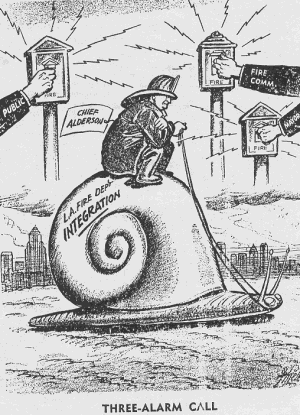
History of the Black Firemen on the Los Angeles Fire Department, 1897 to 1956


History of the Black Firemen on the Los Angeles Fire Department, 1897 to 1956
From the Los Angeles Fire Department Historyical Archives I found this web site that chronicles the history of Black Firefighters through 1956.
Here is an excerpt:
Fire Station No. 14

On November 2, 1936, twelve years after the segregation of Engine 30 the white firemen were removed from Fire Station 14 and it also became all-black. Angry at being removed from their station, the whites trashed the building with garbage and fecal matter. The Battalion Chief ordered them back to clean up their mess.

Click on the link above to read the rest.

Sunday, April 22

Mickey The Fire Cat

Some cats chase rats...not Mickey...he chases fire! Watch this very old video of Mickey the Fire Cat sliding down a pole and going to a fire! 1:22

Wednesday, April 11

The Power of a Fire Hose


Jackass - The Fire Hose - Watch the best video clips here

From Jackass 1: Johnny Knoxville and a firehose. "How much pressure do these things have?"

A reminder....after watching the fire streams w/Johnny (which was somewhat funny)and seeing the force of the hose stream, take a look at the tragic photos from the Civil Rights Demonstrations in Birmingham AL in 1963. They used the fire department- and hose streams- to supress the demonstrators.


Saturday, April 7

25 Years Later, The Caldecott Tunnel Fire Remembered

ContraCostaTimes.com | 25 Years Later, The Caldecott Tunnel Fire Remembered

A multimedia presentation of survivors & responders discussing this horrible incident. For the story click here.

Information on tunnel fire safety can be found by clicking here

The DOT report "Prevention and Control of Highway Tunnel Fires" is here.