Showing posts with label Systems and Equipment. Show all posts

Monday, June 2

The Associated Press: Water pressure blamed for Universal Studios damage


The Associated Press: Water pressure blamed for Universal Studios damage
UNIVERSAL CITY, Calif. (AP) — Authorities will try to determine Monday whether the blaze that destroyed some of Hollywood's most famous backdrops was made worse by low water pressure and an overwhelmed sprinkler system.

At one point, Sunday's fire at Universal Studios was two city blocks wide, and low water pressure forced firefighters to get reserves from lakes and ponds on the 400-acre property. The blaze was contained to the studio's back lot, but it took firefighters more than 12 hours to extinguish it.

"The water pressure situation was a challenge," Los Angeles County Fire Chief Michael Freeman said. "This fire moved extremely fast."

County Supervisor Zev Yaroslavsky said authorities would investigate the water problems to see if they reflect a larger shortfall in the area.

"There's no question that there was a lack of adequate water pressure at least in the perception of a lot of firefighters," he said. "We're going to find out what the problem was."

In addition, the sprinkler system on the outdoor sets was nearly useless, Freeman told the Los Angeles Times for Monday's editions.

The cause of the blaze had not yet been determined.

Friday, March 14

Officials faulted for Santa Ana College fire alarms problems


Officials faulted for Santa Ana College fire alarms problems - Los Angeles Times
Broken devices plagued the campus for two years because of miscommunication, failure to declare an emergency and the belief that a new system would soon be installed, a report finds.
Broken fire alarms at nearly a dozen buildings at Santa Ana College went unrepaired for more than two years because of miscommunication and a can't-someone-else-do-it mentality, and because officials did not declare an emergency to fix the antiquated system, an investigation by a law firm found.

"Everybody thought it was someone else's responsibility," said Eddie Hernandez, chancellor of the Rancho Santiago Community College District.

The investigation was performed by Liebert Cassidy Whitmore of Los Angeles at Hernandez's request after widespread problems that placed thousands of students, faculty and staff in potential danger became public in October.

The faulty alarms had been documented in inspections in 2005 and 2006, but not repaired. The findings of the investigation were released to The Times this week.

Six entire buildings -- including the gym, fine arts building and library -- had no working fire alarms at various times over two years. At least three other buildings had some that worked. Some alarms had broken handles, others did not ring, and at least one was turned off because it would not stop sounding.

Campus and district officials put off repairs because they thought a new system was coming soon, according to the report.

"There was a feeling of 'Why fix these things if they're going to be replaced?' " said John Hanna, a community college district board member. "But that's no excuse."

Officials made another major mistake by not starting a fire watch when they first learned alarms were broken, Hernandez said, which left buildings unmonitored by human or machine.

Meanwhile, officials used the $400,000 in state money that had been earmarked to replace the system to paint and waterproof the exteriors of some of the same buildings that lacked working alarms.

The college's safety committee disbanded several years ago, cutting off one avenue through which the problems could have been reported to a higher level.

If the district board had been notified of the problem immediately, it could have drafted an emergency resolution that could have bypassed the lengthy bidding process and promptly fixed the alarms, according to the report.

That's what the board did once news of the broken fire alarms reached board members in October and the campus newspaper El Don wrote a story about the lapses.

The board acted swiftly, calling an emergency meeting, instituting a 24-hour fire watch and fast-tracking repairs for the aging system.

Less than two months later, the old system was restored to working order.

This month, the board is scheduled to approve a contractor to install a new fire alarm and public address system. That system, at a cost of about $1 million, should be in operation by the end of the year.

Liebert Cassidy Whitmore's report portrays a complicated web of campus and district bureaucracy, with at least six officials passing around information about the broken alarms for two years but taking little action.

For nearly three years before the problem became public, campus and district officials drafted and revised plans to replace the entire system but did not send forward a proposal to repair the existing one, district spokeswoman Laurie Weidner said. "We wanted to make sure we made the right investment," she said. "We don't take the expenditure of public funds lightly."

Santa Ana College President Erlinda Martinez knew the alarms were malfunctioning to some extent, asking in August 2007 for a faulty alarm -- which buzzed constantly -- outside her temporary office to be silenced.

"She had a very stressful day and just wanted the buzzer to be shut off," according to the report.

Martinez has said she did not learn of the broken alarms until inspectors brought the problem to the college's attention in October.

The investigation narrowed in on six officials. At the college: Bruce Bromberger, plant manager; and Noemi Kanouse, vice president of administrative services. At the district: James Wooley, safety and security supervisor; Al Chin, director of safety and security; Don Maus, environmental and safety services manager; and Bob Brown, director of construction and support services, who retired in 2006.

All six were apparently cited in the report for not fulfilling their responsibilities regarding the fire alarms, though how they erred is undetermined because district authorities blacked out names when referring to mistakes they made.

The district also took disciplinary action against those faulted by the report.

Bromberger, who was responsible for the maintenance and repair of fire alarms at the college, resigned in February.

Chin, who is responsible for fire alarm systems at the district and college and communications about safety, was suspended for two weeks without pay.

Kanouse, responsible for facilities maintenance at the college, was transferred to serve as vice chancellor at the district and given a pay cut.

Three other officials received letters of reprimand but kept their jobs.

In reaction to the fire alarm problem, Santa Ana College has reconvened its safety committee, and the district board has formed its own counterpart.

"Thank God no one was hurt and we didn't have to pay the price," Hanna said. "But there were mistakes made. Administrators have been chastised and will see more clearly now. The silver lining is that out of this will come a safer campus."

tony.barboza@latimes.com

Saturday, February 23

Playing with Fire


Reason #9: Why you shouldn't play with fire. Especially in prison.

Thanks go out to Adam S. in our online class for finding this gem!

Thursday, February 14

Agency Sued Over Death of Firefighter at Tower


Agency Sued Over Death of Firefighter at Tower - New York Times

The sister of one of the two firefighters killed in August fighting a fire at the former Deutsche Bank building sued the government agency that owns the building and several contractors on Wednesday, charging they knowingly created dangerous conditions that led to her brother’s death.

Firefighter Robert Beddia, who died in an August fire.
The sister, Barbara Beddia Crocco, contends in the suit that her brother, Robert Beddia, 53, died because of conditions caused during the dismantling of the building, including piles of combustible debris, dismantled fire connections, compromised stairwell walls and barricaded exits.

But in a striking omission, Ms. Crocco did not sue New York City or the city’s Fire Department, even though city officials relieved three senior fire officers of their posts about 10 days after the Aug. 18 fire. Aryeh Portnoy, a lawyer for Ms. Crocco, said his client had not ruled out suing the Fire Department, “at the right time.”

The suit seeks unspecified punitive and compensatory damages. Mr. Beddia and a second firefighter, Joseph Graffagnino, 33, died when a broken standpipe in the basement could not deliver water to the fire, which fire marshals said was probably started by a cigarette. At a news conference in August, Mayor Michael R. Bloomberg said three senior fire officials had been stripped of their command during an investigation into the fatal fire.

The mayor said the local firehouse had failed to conduct any required inspections of the building, which was on the edge of ground zero, since 2006.

Monday, October 1

Flag-hydrant to be reinstalled at dog park


Flag-hydrant to be reinstalled at dog park - Animal Peculiarity - MSNBC.com
Seriously....they removed it. 'Cause dogs might urinate on it. And will now reinstall it. Tax dollars at work!
HILLSBORO, Ore. - The flag-painted fire hydrant that was removed because critics thought dogs would disrespectfully urinate on it is being reinstalled, but with a fence to keep the pooches away.

Unbelievable!

Thursday, September 20

7 Injured, One Critically, In N.J. High-Rise Apartment Blaze


7 Injured, One Critically, In N.J. Apartment Blaze - News Story - WNBC | New York
ASBURY PARK, N.J. -- A fire broke out Thursday in a 15-story apartment building, injuring seven people and temporarily trapping several others on balconies, the city's fire department said.

All seven who were injured, including one critically, suffered smoke inhalation.

The blaze, the cause of which is not known, began around 11:20 a.m. in a cluttered 14th story apartment of the Monroe Towers. The fire forced those living in the top three floors to flee, said Garrett Giberson, an Asbury Park fire inspector.

The apartment's occupant, Sunovia Williams, 80, was pulled out by firefighters who had to crawl over an array of debris that contributed to the intensity of the blaze and hampered efforts to reach her and her husband, Giberson said.

A juvenile, whose age was not immediately available, and five firefighters also suffered smoke inhalation.

The building is one of the tallest buildings in Asbury Park, a community along the Atlantic Ocean. The blaze was initially too high for ladder trucks, forcing firefighters to fight the flames from inside, Asbury Park fire Capt. Frank Dilello said. He wasn't sure if the building had sprinklers, but said there were hose hookups inside.

Monday, August 27

New York Fire Officers Reassigned After Fatal Blaze


Bloomberg.com: Worldwide
According to the Mayor "Inspections are not up for debate."
Three New York City Fire Department officers were stripped of their commands for failing to inspect and plan for a possible fire in the former Deutsche Bank building where an Aug. 18 blaze killed two firefighters, Mayor Michael Bloomberg said.

Deputy Chief Richard Fuerch, Battalion Chief John McDonald and Captain Peter Bosco of Engine Company 10, the firehouse closest to the building near the World Trade Center site in lower Manhattan, were transferred to headquarters, Bloomberg said at a City Hall press conference.

Investigators are trying to determine why Bosco's firehouse failed to inspect the building's water standpipe, which had been broken, every 15 days as law required. The probe will also explore why Fuerch failed to prepare a pre-fire plan for the building under demolition, Scoppetta said.

``These apparent failures in oversight, judgment and responsibility may require disciplinary action,'' Bloomberg said. The mayor said officials are cooperating with separate criminal probes by Manhattan District Attorney Robert Morgenthau and New York state Attorney General Andrew Cuomo.

The officers' reassignments will be temporary until the investigations into the fire are complete, the mayor said.

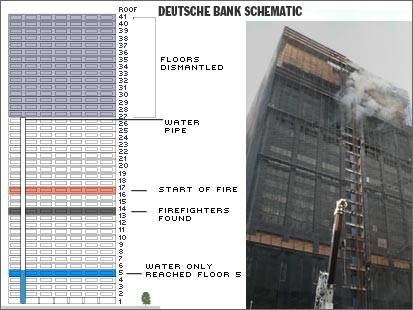
The fire started because demolition workers tossed lit cigarette butts on to the building's 17th floor, said Fire Commissioner Nicholas Scoppetta, who joined Bloomberg at the news conference. The city Fire Marshall ruled out electrical equipment or connections, he said.

``Cigarette smoking was rampant in the building and it was prohibited,'' said department spokesman Francis Gribbon.

Fire Investigation

The mayor said the investigation would seek to answer why the standpipe became inoperable, which left the burning building with no internal water supply, and why it hadn't been inspected, violating city regulations and the contract between the owner of the building, the Lower Manhattan Development Corp., and the demolition contractor, Bovis Lend Lease Co.

``The broken standpipe made it very difficult for firefighters to put water on the fire until they improvised and hoisted hose lines from the street, costing them valuable time,'' Bloomberg said.

Compounding the problem was the presence of plywood and polyurethane placed throughout the gutted building to contain asbestos and other toxic contaminants during the demolition process.

``High-rise fires almost always burn up, not down as this one did,'' the mayor said. ``We suspect that the effects of the negative air pressure system put in place as part of the containment operation pulled the fire down several floors quickly, putting the base of operations on the 14th floor at great risk.''

Failed to Act

Bloomberg said Bosco, captain of Engine Company 10, was reassigned because as commander of the firehouse closest to 130 Liberty Street, he should have ensured inspections of the standpipe were made every 15 days. McDonald, commander of Battalion 1, supervised Bosco.

Scoppetta said Fuerch, a division commander with more than 30 years experience in the department, had failed to act after Battalion Chief William Siegel in 2005 sent him several memoranda requesting that he draft a plan should a fire break out.

`Two Crimes'

John McDonnell, president of the Uniform Fire Officers Association, which represents the three officers, said the building was too hazardous to inspect every 15 days, requiring any firefighters to don protective suits and masks and go through time-consuming decontamination procedures.

``The real problem is that two crimes were committed in that building: someone who removed the standpipe so that water was unavailable, and the people who were smoking in that building,'' McDonald said in an interview. ``Both were criminal and neither fell under the fire department's purview.''

Pre-fire plans should be drafted whenever a demolition or construction site presents unique problems, Bloomberg said. This building, located near the World Trade Center and next door to Engine Company 10, ``where decontamination and demolition require equipment, that makes it a more dangerous situation,'' Bloomberg said.

Black Shroud

The building at 130 Liberty Street, shrouded in black mesh and filled with polyurethane and plywood to contain asbestos and other contaminants, has been vacant since Sept. 11, 2001, when the south tower of the World Trade Center collapsed near it.

The fire killed Robert Beddia, 53, of Staten Island, and Joseph Graffagnino, 33, of Brooklyn. The two worked out of the same firehouse, Engine 24-Ladder 5, that lost 11 firefighters on Sept. 11.

The mayor said the Fire Department's deputy chiefs would inspect all buildings that are under construction or being demolished to make sure of adherence to regulations ``regarding fire protection and public safety,'' the statement said.

``Structurally, we need to also put in place mechanisms to ensure that necessary fire inspections of buildings in our city take place as required,'' Bloomberg said. ``Inspections are not up for debate.''

Saturday, August 25

Firefighters Bid One of Their Own Farewell


Firefighters Bid One of Their Own Farewell - New York Times
RIP
The firefighters in crisp blue uniforms stood in formation for the second successive day, for the second funeral of a fallen comrade, a day after two more of their colleagues were injured at the same site where these two had perished.

There was grief today at St. Patrick’s Cathedral on Fifth Avenue, and even some laughter at a few memories of Firefighter Robert Beddia, a 23-year-veteran of the department who died on Saturday doing the work he loved.

The Rev. John Delendick, a fire department chaplain, told the mourners gathered at the ornate church that Mr. Beddia, 53, “didn’t become a firefighter for the money, he didn’t become a firefighter for the glamour.”

“He became a firefighter because of certain values,” the chaplain said.

But along with the grief there was weary frustration and simmering anger at the circumstances that had claimed Firefighter Beddia’s life.

He died on Saturday along with a colleague, Joseph Graffagnino, while battling a seven-alarm fire in the former Deutsche Bank building in Lower Manhattan, which was in the process of being dismantled. Both were assigned to Engine 24 and Ladder 5, based at a firehouse at Avenue of the Americas and West Houston Street in SoHo.

The fire raised troubling questions about why it had taken so long to bring down the 41-story building that was damaged beyond repair in the terrorist attacks on the World Trade Center in 2001.

On Thursday, as Firefighter Graffagnino’s funeral was taking place in Brooklyn, two more firefighters were injured at the building when a worker lost control of a small forklift on the 23rd floor of the building, sending it tumbling down 200 feet to the ground.

The forklift crashed through a construction shed on the ground level, and part of the shed collapsed on the two firefighters.

Both firefighters, Neil Nally, 35, and William Carbettis, 51, of Engine 258 in Long Island City, Queens, were listed in stable condition today at St. Vincent’s Hospital in Manhattan. They both sustained head injuries.

Firefighter Carbettis had his spleen removed. Firefighter Nally also had an injured back and right hand, according to a fire official, and could be allowed to leave the hospital today, fire officials said.

At today’s funeral for Firefighter Beddia, there were echoes of the funeral on Thursday for his colleague, Firefighter Graffagnino.

At both, bagpipers played “Amazing Grace” for a crowd of mourners that again included Gov. Eliot Spitzer, Mayor Michael R. Bloomberg and Fire Commissioner Nicholas Scoppetta.

And as a backdrop for both funerals, there were thoughts about the troubled building where all four fighters had been harmed, and about why city officials and building owners can’t seem to get to the bottom of the task of bringing down the condemned building.

Mayor Bloomberg, who said he had never met Firefighter Beddia, said he had been described to him by others as a dedicated professional.

“For 23 years he was a quiet hero,” the mayor said at the Mass. “He rarely spoke, but when he did others listened.”

The mayor also talked about the fire that took Firefighter Beddia’s life.

“This fires raised a lot of difficult questions,” the mayor said, adding that city and fire officials would “investigate to get to the bottom of what happened.”

Such an inquiry, he said, would hopefully “lead to actions to make the Fire Department stronger and safer.”

Firefighter Beddia often drove the fire truck for Engine 24, a post referred to as the chauffeur, but when he was not behind the wheel, he was working with the younger men, firefighters said.

Lt. Richie Quinn of the Fire Department spoke to reporters outside St. Patrick’s today about Firefighter Beddia.

“He was our chauffer, he knew every building inside and out, which was extremely helpful for us,” he said.

Firefighter Beddia’s sister, Susan Beddia Olson, spoke about him before his flag-draped coffin, in the form of a letter to him, which she began by saying, “Dear Bobby,” the name those close to him called him.

“Remember walking me down the aisle?” she asked. “Remember dancing with me at my wedding?

“You are my friend, you are my brother,” she said. “You are my hero.”

Two hours after the funeral mass had begun — as the family and other mourners accompanied the coffin out of the cathedral, from where it will be taken to a cemetery in Staten Island for burial — hundreds still lined Fifth Avenue.

A church bell tolled, and the crowd went silent as Firefighter Beddia was led out of Manhattan, a borough whose streets he knew so well, for the last time.

Wednesday, August 22

Critics Say Lessons From 9/11 Were Not Followed in Deutsche Bank Blaze


After the Sept. 11 attack at the World Trade Center, an independent consultant studied the Fire Department’s performance and identified a number of lapses amid all the undeniable valor of that day. It said that too many men rushed into the buildings before anyone realized the danger they were in, contributing to the staggering death toll.

The consultant, McKinsey & Company, said the Fire Department needed to use more caution and preparation when it approached such a major, complicated fire, and not send too many men in before it knew what it was dealing with.

Saturday’s fire at the former Deutsche Bank building, which left two firemen dead, presented its own set of challenges, but it also bore similarities to Sept. 11 that went beyond geography, including the fact that the building was a high-rise.

Now, some are questioning Saturday’s response, noting that, at one point, more than 100 firefighters were inside the building even though the fire was out of control and wildly unpredictable — and that those men had to be called out. And they were inside even though, unlike the situation in the twin towers, no workers were trapped.

“Clearly firefighters were sent into a deathtrap,” said Stephen J. Cassidy, president of the Uniformed Firefighters Association. “I think the Fire Department’s position is they didn’t know how bad it was. We certainly need to find out why they didn’t know.”

Yesterday, Fire Commissioner Nicholas Scoppetta directed his investigators to determine why the department did not have a plan in place to fight a fire in the building.

Mr. Cassidy made his remarks as the Manhattan district attorney, Robert M. Morgenthau, announced that his office had opened an investigation into the fire to determine if any crimes had been committed. The move extends the prosecutors’ subpoena power to the fire marshals who are working with the district attorney’s office.

Mr. Cassidy also called for an independent investigation of the fire by the state attorney general, Andrew M. Cuomo, who said last night that his office had begun reviewing the circumstances of the fire. Mr. Cassidy said the department was “not capable” of doing its own investigation because of its own involvement and its relationship with other city agencies involved.

In a way, it is a debate that goes to the heart of Fire Department culture — rushing into burning buildings, after all, is what firefighters do. And for their part, fire officials said they believed that Saturday’s fire was well managed, and that the department’s response could not be compared to its actions on 9/11.

“This is a fire in a high-rise building; it is not a terrorist attack,” said Francis X. Gribbon, the department’s chief spokesman. “They see the fire, they know where the fire is. They use the protocols in place to fight the fire.”

Mayor Michael R. Bloomberg defended the department’s decision to send the more than 100 firefighters up into the building to fight the blaze, saying they bravely improvised in a crisis.

The Deutsche Bank building is being dismantled. Sheathed in black netting and plywood, the floors where the men were trapped had been sealed off with plywood and plastic sheeting, creating a maze that became especially daunting as the building filled with wind-fanned black smoke.

Radio transmissions captured the moment when high-ranking officials ordered all the men out — a striking echo of Sept. 11. With two men down and 29 Maydays coming from hellishly fire-engulfed floors, commanders wanted to do a head count.

The priorities of those in charge of the fire response are crystallized in one transmission: A senior official cursed as he said he did not care about the building, and shouted, “Where are my men?”

Firefighters were trapped without water because the standpipe system — plagued by a shut valve, cracks and a broken pipe — malfunctioned. The two firefighters who died, Robert Beddia, 53, and Joseph Graffagnino, 33, ran out of air. Investigators are focusing on a discarded cigarette or faulty electrical panel as the cause of the blaze.

“This was an unoccupied building,” said a former fire official. “On 9/11 we sent too many people in. McKinsey said that we should not rush men in and, even though the investigation is ongoing, it seems obvious at this point that we still have not learned the lesson that if you’re going to send people in, there should be adequate time and means to get them out.”

Charles R. Blaich, a retired deputy chief who was in charge of safety for the Fire Department at the ground zero site, said the McKinsey report changed how the department managed disasters.

“After 9/11 there were directions that came out from the chief of department that we never get ourselves into a position at these huge disasters where we just blindly assign assets without reasonably assessing what risks we face and what benefits we will achieve,” Mr. Blaich said. “What are we going to achieve by doing this?”

Thomas Von Essen, the fire commissioner on Sept. 11, said he had had many conversations with firefighters who responded on Saturday. He said many felt the operation had moved too quickly.

Mr. Von Essen said it was widely known that the bank building was undergoing a complex and dangerous demolition. He said fire officials should not have been surprised by what the firefighters encountered.

John J. McDonnell, the president of the Uniformed Fire Officers Association, said he believed the lessons of Sept. 11 had been learned “to some extent.”

“I don’t know if the upper echelons of the Fire Department were aware of the complex nature of the abatement within the building, I mean everyone from the fire commissioner to his staff,” said Mr. McDonnell, whose union represents 2,450 members.

“Were they aware of the complex nature?” he asked. “If they were aware prior to that, maybe there would have been a different fire plan in place.”

He added, “Under a hazardous materials condition, you approach things on a much more cautious level. ”

Firefighters at the scene checked in with commanders, said Mr. Gribbon, the department spokesman. “They were given assignments and they went to work.”

Mr. Gribbon declined to release a minute-by-minute breakdown of the department’s response because he said the department was conducing an internal review that involved listening to radio transmissions, transcribing the tapes, interviews and re-interviews, among other things.

Mr. McDonnell said no one had been prepared to find the stairwell landings blocked by the heavy plywood boards used to compartmentalize buildings where asbestos was being removed. Firefighters had to use an exterior elevator and scaffolding stairs to get up and down.

Jerome M. Hauer, director of the city’s Office of Emergency Management from 1996 to 2000, said it was “unfair” to contrast the department’s operations on Saturday with the findings of the McKinsey report because “I don’t feel that the report was accurate in some of its assessments.”

He said the accountability for what occurred “has to rest” with the building owner and the demolition operators, not with the Fire Department.

Subcontractor at WTC site dropped after fire


The abandoned Deutsche Bank building was filled with hazardous chemicals, holes in the floors and a maze of plastic sheeting that made it a virtual death trap for firefighters.

Yet the New York City Fire Department did not have a contingency plan for fighting a fire there, as is required for every building in the city, city and fire officials said Wednesday.

The building's central water pipe, which was disconnected on Saturday, the day of the fire, and is one of the factors being blamed for the deaths of two firefighters, also was not being inspected regularly as the law requires, city and fire officials said.

"Things didn't go right," Steve Cassidy, president of the Uniformed Firefighters Association said Tuesday. "In the end, we lost two firefighters in a toxic building that's about to be torn down. It's unacceptable that it happened."

Both Manhattan District Attorney Robert Morgenthau and state Attorney General Andrew Cuomo launched investigations into the fire this week.

Meanwhile, a controversial subcontractor in the project, the John Galt Corp., was let go Wednesday, days after it was revealed that both the city and federal governments had issued it numerous violations for problems including holes in the floor, falling debris and sparks flying near combustible material.

The Fire Department is still investigating how the deadly blaze started Saturday afternoon, city officials said Wednesday.

The firefighters killed, Joseph Graffagnino, 33, of Brooklyn, and Robert Beddia, 53, of Staten Island, will be buried Thursday and Friday, respectively.

Cassidy said for more than a year before the fire, local firefighters were not allowed into the building to do regular inspections because of the poor air quality there. He is asking who was doing the inspections, if not the local firehouse.

Fire Department spokesman Jim Long said the department is looking into why there was no pre-fire plan for the building and why the department was not inspecting the water pipe regularly.

However, even if the fire department was not doing regular inspections of the water pipe, the city building department was, city officials said. According to building department records, only the day before the fire, an inspection showed that the pipe was assembled properly and seemed to be working.

When it was taken apart -- part of the pipe was found lying on the floor after the fire -- remains a mystery, city officials said.

Work on deconstruction of the building was stopped immediately after the fire, and now that John Galt has been taken off the project, it isn't likely to resume soon.

In a letter to John Galt explaining why the company's contract is in default, James Abadie, the principal-in-charge of Bovis Lend Lease, the primary contractor, said: "The numerous citations issued with respect to employee safety and the failure to properly maintain all required site safety precautions are only some areas of concern."

Fire Dept. Did Not Inspect Pipe in Doomed Building


The New York Fire Department failed to visually inspect standpipes in the former Deutsche Bank building every 15 days as required by city rules for buildings being demolished, and had not done any inspections at the building since November 2006, according to records released yesterday by City Hall.

The standpipe system’s readiness to perform in a fire was last checked in November 1996, when the building was a functioning office building, and the system was filled with water and tested with pressure gauges, the Bloomberg administration said. Under fire codes, it is the building owner who must do such water, or hydrostatic, tests.

The Sept. 11 terrorist attack on the World Trade Center stymied plans for the next water test of the system at the Deutsche Bank building, at 130 Liberty Street, in November 2001, and no further testing of the system was required because the building, mortally damaged, was likely to be demolished.

Investigators have zeroed in on the building’s standpipe as they investigate last Saturday’s fire and exactly what led to the deaths of two firemen, Robert Beddia, 53, and Joseph Graffagnino, 33, who were battling it. The standpipe was not operational before the fire broke out, according to an administration news release.

A standpipe valve between the basement of the first floor of the building was shut, and the network of pipes that is supposed to deliver water from fire trucks in the street to the standpipe system’s connections was compromised, officials said. Also, a piece of the standpipe system was missing altogether and was found lying in the building’s basement.

A city official said it appeared that the twice-monthly standpipe inspections that are mandatory for buildings under demolition were never done. It is unclear whether the potential environmental dangers due to toxins in the building kept firefighters from making the inspections, the official said.

Investigators in the office of Manhattan district attorney Robert M. Morgenthau visited the basement of the building yesterday and took photos.

One fire investigator said that the law enforcement officials were struck by how damaged the standpipe was. The investigator also said it appeared that workers had been staying in the basement overnight, in violation of an order to keep people out.

The records released by City Hall — a possibly incomplete list based on “paper records” that the Bloomberg administration has so far reviewed — offered a sober assessment of the Fire Department’s oversight at the building.

They also show that the department was aware of reports that the sprinkler system was not working. That failure is also under investigation. Buildings Department inspectors visited the skyscraper to approve the dismantling of each floor, and determined that the standpipe had been properly capped on the floor below.

A fire official noted yesterday that firefighters were in the building for reasons other than inspections, once when a pipe fell from the building last spring and crashed into a nearby firehouse. Fire personnel were also in the building in August when citations were issued to the contractors, the officials said.

The records also detailed a series of violations that have been issued by the Buildings Department against Bovis Lend Lease, the contractor overseeing the entire demolition project, and the subcontractor in charge of the demolition, the John Galt Corporation.

Bovis was cited on June 6 for a “large amount of combustible material/debris” accumulating. The subcontractor was cited on Aug. 1 because “burning operations,” were causing sparks to fly; and on Aug. 3 for an expired certificate to “store/use acetylene.”

Investigators are focusing on a discarded cigarette or faulty electrical panel as the likely cause of the blaze.

The last time fire officials from Engine 10 — which is in the skyscraper’s shadow — did a “regular surveillance inspection,” in the building was March 31, 2006, the records show.

The Assembly speaker, Sheldon Silver, the State Legislature’s top Democrat, said he found the lack of recent water tests, “incredible. It’s amazing.”

“This is really a shock that even five years before Sept. 11, much less since Sept. 11, nobody checked that out,” said Mr. Silver, who represents residents of Lower Manhattan. “There are very serious concerns about that. The community has been overwhelmingly concerned about that building.”

The Buildings Department has conducted daily inspections of the floors under deconstruction since March 19, said Kate Lindquist, a department spokeswoman. The most recent inspection prior to the fire was the day before it broke out, she said, when an inspector confirmed that the standpipe was capped on the floor below deconstruction.

It is unclear when anyone from the Buildings or Fire Departments last inspected the standpipe system in the basement, where the broken pipe was found.

“That is one of the questions we are trying to answer,” said Ms. Lindquist. “We are reviewing our inspection reports.”

The law does not require the Buildings Department to conduct comprehensive testing of the standpipe system, she said. But a licensed site-safety manager is required to visually inspect the standpipe and its valves — to ensure they are connected properly — every day, the city official said.

Monday, August 20

Standpipe Flaw Examined in Fire at Ground Zero


Standpipe Flaw Examined in Fire at Ground Zero - New York Times
The Fire Department is investigating whether a malfunctioning standpipe sent water cascading into the basement of the flaming Deutsche Bank tower at ground zero on Saturday, denying water to air-starved firefighters battling the seven-alarm blaze above, including the two men who were killed.

Members of Engine Company 7 said they connected their hose to the standpipe and pumped thousands of gallons into the building, but one investigator said yesterday that the water never made it beyond the fifth floor, leading to suspicions of a cracked or broken valve. The basement, officials said, was filled with water.

Firefighters were forced to spend crucial moments carrying and pulling hoses up the sides of the ghostly black-shrouded building — a scarred remnant of the 9/11 attacks that was being dismantled — as wind-driven flames caught on 13 different floors after snaking up and down through voids and holes.

Officials were still trying to determine the cause of the blaze, suspecting either a tossed cigarette or a faulty electrical panel, but one thing was clear: From the beginning, even before the standpipe failed, the blaze presented a series of unique challenges to those fighting it.

The building had been contaminated by the fallout of Sept. 11 with toxic substances and tiny bits of human remains; insurance fights delayed its fate for years. Asbestos had been removed from the building, and sealed plywood hatches in stairwells divided the floors, forcing firefighters — possibly including the two who died — into the wide-open floors, where they could easily become disoriented.

Containment areas of plywood and thick plastic sheeting meant to keep in potentially dangerous particles sucked in air, fanning flames. Plywood that had replaced windows on the upper floors can be seen burning in photographs.

Flames got around and under the firefighters who died, Robert Beddia, 53, and Joseph Graffagnino, 33. A voice believed to be that of Firefighter Beddia was heard on a radio transmission saying he had run out of air and was trying to follow his hose out. It may have been his last transmission.

“There were problems getting water on the fire,” one official said. “They are trapped and they run out of air because of how rapidly the conditions change, and now they have no refuge and they cannot get out. They now cannot see and they have no air.”

Gov. Eliot Spitzer and the Lower Manhattan Development Corporation, the state agency that owns the building, promised investigations, and an official with the federal Occupational Safety and Health Administration said the agency had cited the John Galt Corporation, the subcontractor doing the demolition, for 20 serious violations at the building.

At the same time, officials said that results of air test results from around the building were negative for asbestos, but that it would take several days before they knew about other substances.

Residents in the area expressed an array of frustrations.

“You’d think that after six years, we would have learned something, but when this fire broke out, there was no notification system in place, and the people who live around here didn’t know what to do,” said Patricia L. Moore, who lives at 125 Cedar Street, in the shadow of the burned building. “Some of us left the building and some of us stayed, but we’re all concerned.”

Avi Schick, the chairman of the Lower Manhattan Development Corporation, said the fire was a “perfect storm of misfortune that worked together to turn what is, under any circumstance, a hazardous situation into something that was perhaps even more treacherous.”

Mr. Schick said the mechanism to ensure negative air pressure within the containment areas might have worsened conditions by bringing in a supply of outside air that wound up feeding the flames and by drawing smoke across the floor without fully venting it, since the exhausts have filters designed to trap particles in the air.

“It’s likely that the very measures that were insisted upon by the E.P.A. to protect those on the outside had a less than salutary effect when the fire started, because there were too many pulls on the oxygen,” Mr. Schick said. “And the firefighters paid the ultimate price.” Officials said the fire would delay the dismantling of the building by about three weeks.

Sunday, August 19

BREAKING: 21 students treated in gas leak


BREAKING: 21 students treated in gas leak
Earlier today 21 Virginia Tech students were treated for carbon monoxide poisoning in the Collegiate Suites apartment complex off Patrick Henry Road.

Five females were found unresponsive in one apartment and were flown to hospitals by helicopter, said Blacksburg police Capt. Bruce Bradbery. Two were sent to the University of Virginia Medical Center on ventilators, and the three other were sent to Duke University Medical Center. Four of the young women remain unresponsive; one female transported to Duke has regained partial consciousness, Bradbery said.

The five young women who were sent away via helicopter were all living in the same apartment at 1306 Henry Lane. They were found after a nearby resident called the gas company of the complex to investigate a smell, Bradbery said.

Seventeen other people were taken to Montgomery Regional Hospital for treatment, Bradbery said.

Bradbery said that the level of carbon monoxide to begin indication of symptoms is 25 parts per million (ppm). When the fire department conducted a reading after the building was evacuated, the reading reached 500 ppm. After 30 minutes of ventilation, that reading went down to 200 ppm.

Bradbery said that after a preliminary investigation the leak was caused by a faulty pressure relief valve in the hot water heater. Because the valve was open, the fuel was constantly burning and the carbon monoxide was not ventilating.

In addition, all four doors inside the apartment were closed preventing the carbon monoxide from exiting.

The Blacksburg police received a call at 11:18 a.m. and reached the scene at 11:23 a.m.

There were no carbon monoxide detectors in the building because there is no requirement for them.

The apartment will be sealed indefinitely and investigated thoroughly, Bradbery said. Residents are allowed to enter to gather last minute items. The fire department is providing housing for them in a local hotel.

Fire at WTC was hard to fight


Air-quality tests on asbestos negative
A fire that killed two firefighters in an abandoned skyscraper near ground zero may have been harder to fight because of the protective polyurethane on several floors in the building, Gov. Eliot Spitzer said Sunday.

The former Deutsche Bank office building has been a toxic site since it was damaged on the morning of the 2001 World Trade Center attack, and was in the process of being disassembled. The federal Environmental Protection Agency had required the polyurethane sheets to prevent asbestos and other harmful debris from leaking out, Spitzer said.

The polyurethane in the building "may in fact have made this fire harder to fight," Spitzer said.

Questions about other complications were emerging on Sunday, including why the building's standpipe, or source of water, did not work, forcing firefighters to run hoses up to the 17th floor, where the fire started.

"The standpipe was not operating. We don't know why yet," fire department spokesman Frank Gribbon said.

Friday, June 22

Flying fire hydrant kills Oakland man


Wow...talk about being in the wrong place a the worst time...
OAKLAND _ Humberto Hernandez never saw the 200-pound flying piece of iron that killed him and veteran police officers could not remember ever seeing anything like this accident.
Hernandez, 24, was killed Thursday evening when he was hit by an airborne fire hydrant that was dislodged from the sidewalk when it was struck by an SUV, police said.

Motorcycle Officer Eddie Bermudez, who is investigating the death, said Friday it was ``a million-to-one chance'' that something like this could happen to someone.

Bermudez said if Hernandez had been one step ahead or one step behind where he was on the sidewalk ``he would not have gotten hit.''

Police said the hydrant hit Hernandez _ who was walking with his wife _ in the back of the head, skipped off him and hit a fence before landing another 20 feet away.

Lt. Fausto Melara, a 25-year veteran and a longtime motorcycle officer, said, ``I've seen a lot of accidents but never anything like this.

``I've seen people hit fire hydrants but never anyone killed by a flying fire hydrant.''

Police said Hernandez was walking with his wife in the 900 block of 98th Avenue _ a short distance from his home _ about 5:52 p.m. Thursday.

Bermudez said Hernandez had just bought his wife some flowers and some cherries and they were walking to a restaurant at 98th Avenue and International Boulevard to have dinner.

Police said a 2007 Ford Escape driven northbound on 98th by a 45-year-old Danville woman who said a tire blew before the vehicle swerved onto the sidewalk.
Bermudez said police have not confirmed that the tire blew. He said the driver told police she was not talking on a cell phone or was distracted in any other way.

When the SUV smashed into the hydrant, the impact and released water launching it at a 45-degree angle toward Hernandez, who was about 10 feet away walking northbound on same side of the street.

Police are not sure if the hydrant might have skipped off the pavement before hitting 5-foot-6 Hernandez in the back of his head.

``He was walking a bit ahead of his wife and then, all of a sudden, he is in the line of fire,'' Bermudez said.

After hitting Hernandez, the hydrant still had enough velocity to ricochet through a fence before stopping.

That was especially surprising to police, including one officer who said, ``You can't even pick those things up.'' Hernandez was pronounced dead at the scene. His wife was not hurt.

Thursday, May 24

Next Up for Lost Whales: Fire Hoses


ABC News: Next Up for Lost Whales: Fire Hoses
Another use for fire hose....
Rescuers Plan to Use Fire Hoses to Coax 2 Wayward Whales Back to Pacific
Marine biologists said Thursday that they planned to spray fire hoses in a river near two lost, injured whales in the next attempt to coax the pair back toward salt water.

The method has never been tried before, and biologists don't know how the whales will respond Friday. If the whales like the spray, crews will try to lure them back to the ocean; if they hate it, they'll try to force them there.

Biologists planned to spray near the whales both above water and underwater from the deck of a boat on the Sacramento River. The approach comes after attempts to lead them back to sea using the sounds of clanging pipes, feeding humpbacks and killer orcas failed.

The mother whale and her calf were last spotted about 70 miles from the ocean, in an area of the Sacramento River where they have been circling for several days, said Carrie Wilson, a biologist with the state Department of Fish and Game.

Saturday, May 19

Fire Marshal: Gorham Schools Violate Fire Code


Fire Marshal: Gorham Schools Violate Fire Code - Local News Story - WMUR Manchester
GORHAM, N.H. -- An inspection of the high school in Gorham found numerous fire code violations, including a locker room without a second exit and a bowing wall in the gym, according to the fire marshal.

An inspector from the state Fire Marshal's office said work to correct the problems "must begin immediately." He toured schools in the Gorham-Randolph-Shelburne Cooperative School District at the request of Superintendent Paul Bousquet.

The girl's locker room at the high school should be closed until a second exit is installed, fire inspector Charles Chalk wrote in his report. The gym also could be off limits if an engineer finds that the bowing exterior wall is unsound.

The high school's chimneys need to be evaluated and repaired, and the fire extinguishing system in the school kitchen must be updated, he said. In the meantime, the stove may not be used to cook any greasy food.

Chalk also found that the building's entire fire alarm system is unsafe. It consists of a hodgepodge of "manual activation devices, some heat detectors, some smoke detectors and a partial sprinkler system," he wrote. "Upgrading must begin immediately."

He found several fire code violations at the Ed Fenn School, as well, including an inadequate rescue window in the speech therapy room. He suggested that the district hire a licensed fire protection engineer.

Wednesday, May 16

Deluge Test gone wrong


Test of a deluge system in an aircraft hangar. They thought they were going to be able to turn it off. Not so much. Good music-Enjoy!