Showing posts with label Liability. Show all posts

Wednesday, February 18

Firefighters in gay pride parade were sexually harassed, jury says - Los Angeles Times


Firefighters in gay pride parade were sexually harassed, jury says - Los Angeles Times
The four men sued the city after being ordered to drive a fire truck in the parade. The jury awards them $34,300 in damages.
By Tony Perry
February 19, 2009
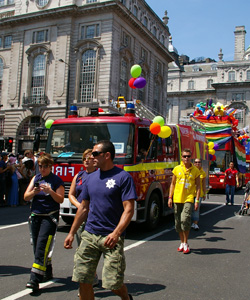
Reporting from San Diego -- A Superior Court jury Tuesday found that four male firefighters were sexually harassed while driving a fire truck in the 2007 gay pride parade and were entitled to a combined $34,300 in damages from the city.

The four sued the city because they were ordered to drive the truck in the 90-minute parade even though firefighters in previous gay-pride parades had reported being taunted with sexual innuendoes.


The jury ruled that each of the four should receive $5,000. One should receive an additional $14,200 because he felt compelled to transfer to a different fire station after the incident, and another will receive $100 as reimbursement for a co-pay for a counseling session.

"The amount itself is not important -- the city disrespected these men and violated their rights," said their attorney, Charles LiMandri.

The Fire Department violated its own anti-sexual-harassment policy by forcing the four into the parade over their objections, the jury concluded after two days of deliberation.


A jury in September was unable to reach a verdict. In that trial, the firefighters' attorney asked the jury to award each firefighter from $500,000 to $1 million.

Since the lawsuit was filed, Fire Chief Tracy Jarman, who marched in the parade, has changed departmental policy, making participation in parades voluntary. The city attorney's office, which represented the Fire Department in the lawsuit, plans an appeal.

Wednesday, November 19

Bonfire built by students caused Montecito fire, sheriff says


The students did it!! Say it aint so.....Click the link above for the full story, or enjoy the video...

Wednesday, September 3

Great White offer $1 million to gig fire victims

100 people died at the rockers' show

Band members from rock band have agreed to pay $1 million in total to survivors and victims families who were in a fire sparked by their pyrotechnics during one of their shows.

The gig took place at The Station nightclub in February 2003 in West Warwick, Rhode Island, USA, after sparks from pyrotechnics used at the opening of the show ignited foam that was used for soundproofing around the stage.

Approximately 100 people died, including guitarist Ty Longley, and 200 people were injured in the tragedy which, according to Associated Press, was the fourth deadliest fire in American history.

The once Grammy Award-nominated did not admit any wrongdoing as part of the settlement payment.

Their offer makes a total of about $175 million offered by dozens of defendants to settle lawsuits after the blaze.

After the fire survivors and victims' families sued several dozen defendants such as foam companies, a rock radio station that ran adverts for the gig, the club's owners and the local fire marshal.

The band's tour manager, Daniel Biechele, who shot off the streams of pyrotechnics that started the blaze at the start of the show, pleaded guilty to 100 counts of involuntary manslaughter in 2006 and was recently paroled having served half of his four-year sentence.

Wednesday, March 26

Boy Not Competent for Fatal Fire Charges


The Associated Press: Boy Not Competent for Fatal Fire Charges
GREENVILLE, Ohio (AP) — A 10-year-old boy accused of deliberately starting a fire that killed his mother, younger sister and three other children was ruled not competent Tuesday to face juvenile counts of murder and arson.

Judge Michael McClurg dismissed the charges against Timothy Douglas Byers in Darke County Juvenile Court.

Police say the boy admitted setting the Sept. 16 fire in this western Ohio city but did not intend for anyone to die.

However, Byers' attorney, David Rohrer, has said his client denies the charges and was pressured into giving the purported confession.

Two psychologists, one hired by the court and the other by the prosecution, found that Byers did not have the developmental maturity to understand the proceedings or to aid his lawyers in his own defense.

"The evidence clearly shows he doesn't understand," McClurg said.

McClurg ordered the boy to perform 40 hours of community service, return to school and attend a fire safety class. The judge said he would review the case in six months. He declared Byers a ward of the state but left him in temporary custody of a grandmother.

The victims were the boy's mother, Chanan Palmer, 30, and his sister, Kaysha Minnich. Also killed were the children of housemate Christy Winans: Kayla Winans, 6, Je'Shawn Davis, 5, and Jasmine Davis, 3.

Dezirae Jones, an aunt of some of the victims, told the judge that she forgives Byers.

"But there are four children and an adult lady ... I will never be able to see them again," Jones said as tears ran down her face. "I wish we could figure out what happened."

Thursday, February 14

Agency Sued Over Death of Firefighter at Tower


Agency Sued Over Death of Firefighter at Tower - New York Times

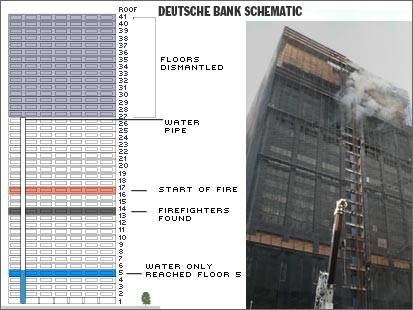
The sister of one of the two firefighters killed in August fighting a fire at the former Deutsche Bank building sued the government agency that owns the building and several contractors on Wednesday, charging they knowingly created dangerous conditions that led to her brother’s death.

Firefighter Robert Beddia, who died in an August fire.
The sister, Barbara Beddia Crocco, contends in the suit that her brother, Robert Beddia, 53, died because of conditions caused during the dismantling of the building, including piles of combustible debris, dismantled fire connections, compromised stairwell walls and barricaded exits.

But in a striking omission, Ms. Crocco did not sue New York City or the city’s Fire Department, even though city officials relieved three senior fire officers of their posts about 10 days after the Aug. 18 fire. Aryeh Portnoy, a lawyer for Ms. Crocco, said his client had not ruled out suing the Fire Department, “at the right time.”

The suit seeks unspecified punitive and compensatory damages. Mr. Beddia and a second firefighter, Joseph Graffagnino, 33, died when a broken standpipe in the basement could not deliver water to the fire, which fire marshals said was probably started by a cigarette. At a news conference in August, Mayor Michael R. Bloomberg said three senior fire officials had been stripped of their command during an investigation into the fatal fire.

The mayor said the local firehouse had failed to conduct any required inspections of the building, which was on the edge of ground zero, since 2006.

Monday, December 3

Student Paper's Fire-Alarm Article Leads Santa Ana College to Begin Hourly Patrols


Student Paper's Fire-Alarm Article Leads Santa Ana College to Begin Hourly Patrols - Chronicle.com
Student Paper's Fire-Alarm Article Leads Santa Ana College to Begin Hourly Patrols
Santa Ana College has begun hourly fire patrols in seven buildings because their fire alarms are not working — and in some cases have been broken since 2005, according to the Orange County Register.

Problems with the alarms were revealed last week by the community college’s student newspaper, El Don. Subsequently the board of the Rancho Santiago Community College District, of which the college is a part, met in emergency session to begin the process of buying a new central alarm system for the campus. In the meantime, the college is seeking parts to repair the existing alarm systems in individual buildings. Repairs are expected to take about a month.

El Don reported that alarms in some buildings had been switched to a “silent” mode, rather than getting needed repairs, and that in the gym alarms were not working and water lines leading to fire hoses had been disconnected. College officials said the general counsel’s office had begun an investigation aimed at finding out who is to blame for the alarm failures.


Photo Sharing and Video Hosting at Photobucket
But why stop there???

Fire alarms broken at Santa Ana College: Some officials knew of problem for two years.
SANTA ANA - Fire alarms are not working at seven buildings at Santa Ana College as part of a longstanding problem that was known but not addressed, officials confirmed this week.

Until the alarms are fixed, the buildings are on manual "fire watch" during which a security guard manually patrols looking for problems at least once an hour while people are in the buildings.

College trustees were not told about the broken alarms which in some cases date back to 2005 and originally involved as many as 11 buildings, said John Hanna, president of the board of the Rancho Santiago Community College District, which operates the college.

"We're furious about this," Hanna said. "People in management were informed and nothing was done."

The seven buildings on manual fire watch are the Cook Gym, Hammond Hall, Phillips Hall, the Library, and the Administration, Fine Arts, and Security buildings, officials said.

The issue became public this week only after the El Don college newspaper published an investigative story about the system. The district board held an emergency meeting Tuesday night to approve a request for bids for a new alarm system which could take as much as two years to install.

Meanwhile, parts are being sought to fix the antiquated, standalone, bell-type fire alarms and they should all be fixed in about a month, officials said.

"Everything will be functional within the next 20 to 30 days," college President Erlinda Martinez said. "Each building will have 100 percent of its alarms functioning."

Martinez said she only found out about the problem "a few weeks ago" during a meeting of the campus facilities committee.

The problems came to light in 2005 and 2006 inspection reports, but there are no records that anything was ever done with the information. Campus safety officials told the El Don campus newspaper they had reported the problems but repairs were not made.

Minutes from previous facility committee meetings over the last two years do not show any mention of problems with fire alarms, despite written reports about them.

In some cases, problems with the bells ringing caused officials to simply disable them instead of repairing them.

A May 2006 inspection report shows not only rusted and non-working alarms, but also many panels that had dead batteries and other routine maintenance that had not been performed.

The El Don reported that alarms in two buildings had been switched to "silent mode" rather than having been repaired.

The paper also reported that alarms inside Cook Gymnasium, scene of large athletic events attended by hundreds, are not working and its fire hoses were disconnected from water lines.

An investigation by the college's general counsel's office is underway to determine what happened and who is at fault, officials said.

The college had money to make the repairs from hundreds of millions in bond money that the district had acquired for building construction and renovations. Thirty million dollars of that pool was used to build a new sheriff's academy that recently opened.

The problem seemed to have been related to a decision to replace the standalone ringing alarm bells with a new technology that will allow all the buildings to be connected to a central panel in the campus security building.

Instead of repairing broken alarms, campus staff apparently did nothing because of plans to install the new system. However, no bid requests ever went out for the new system until this week, Hanna said.

"It boggles the mind why that wasn't done," Hanna said. "Had someone come and asked us for money to get that done, we would have given it to them."

Santiago Canyon College, also operated by the same district, used deferred maintenance funding to repair its alarm system in 2005 and 2006, Hanna said.

Even in the October facilities meeting in which the issue came to light, Hanna said no mention was made of the broken alarms until a concerned faculty member brought it up.

Martinez said that the college has hired Pyro-Comm of Huntington Beach to make temporary repairs on the standalone system and will seek bids to install a modern system called "Notifier."

It is against state law for classroom buildings to not have working fire alarms.

Santa Ana Fire Marshal Lori Smith said the city is aware of the problem and that the college voluntarily proposed the plan to have a security officer patrol buildings hourly whenever students are present.

"They are under notice to repair the existing system and get it working," Smith said.

Martinez said that college officials are also looking into reports there may be problems with sprinkler systems and water hydrant pressure. "We are following up on everything that was brought up," she said.


But wait! There is more!

Faulty fire alarms at Santa Ana College put thousands at potential risk:
The alarms have been broken since 2005, according to contractor reports. 'Something's rotten, trustee board president said, 'and we're going to find out about it.'
Seven buildings at Santa Ana College, including the administration offices and the library, have faulty fire alarms, placing thousands of students, faculty and staff in potential danger.

The alarms have been broken since at least June 2005, according to reports given to the school at that time by a contractor the college hired. Some have broken handles, others do not ring, and at least one was turned off because it would not stop sounding.

The Rancho Santiago Community College District has hired a law firm to find out why nothing was done for more than two years after reports documented the problems.

"It is an unacceptable practice to compromise the safety of our students or visitors," said Board of Trustees President John Hanna, who called an emergency meeting Tuesday for trustees to pass a resolution to repair the alarms. "Inspectors don't issue reports just for the fun of doing it. Somebody knew about this and made a conscious decision not to do anything about it. Clearly something's rotten in Denmark, and we're going to find out about it."

Inspections completed in 2005 and 2006 revealed widespread problems with the college's 1960s equipment, citing several buildings that lacked working fire alarms.

In some of those cases, campus security would not have known if there were a fire because the system makes noise only in the building where the alarm is pulled and does not alert authorities. The campus security building is one of those where the alarms don't work.

The college district in 2003 earmarked $400,000 in state maintenance funds to go toward replacing Santa Ana's nearly obsolete fire alarm system, but four years later, the overhaul has not been started.

The problems came to the attention of top district officials last month. Short-term repairs approved at the board meeting, expected to cost $68,000, should be completed in about a month. Meanwhile, security guards at the college have started a fire-watch program and hourly are patrolling buildings without alarm coverage. Other buildings without working alarms include the gym, the fine-arts building and the theater.

Three portable classrooms also had broken alarms, but they recently were fixed.

"I'm not sure whether it was a communication thing, a process thing, or an individual person thing," district Chancellor Eddie Hernandez said. "This should not have taken this length of time to solve it. There are plenty of people in retrospect that dropped the ball." Santa Ana Fire Department officials, who annually review the college for fire code violations, do not inspect fire alarms but rely on the college to hire a contractor to ensure they are working.

The college's fire alarms date to about 1966, making replacement parts nearly impossible to find, according to a contractor's report this month.

Officials said the district will replace the old alarm system with one that will notify security staff of fires and include loudspeakers and strobe lights.

It could take as long as two years before the new system, expected to cost between $1.5 and $2 million, is installed.

Santa Ana College President Erlinda Martinez said she did not learn of the broken fire alarms until inspectors brought it to the college's attention again last month. She declined to state which college officials had known about the broken alarms in 2005, saying only that reports about the alarms "didn't rise to the level to where we took action."

Hernandez , the district chancellor, said he was certain some school administrators knew about the problem. "This is a classic case of something falling through the cracks, but safety should come to the top of everyone's list."

Santiago Canyon College, which is part of the same community college district, finished replacing its alarm system in 2005, after two years of construction at a cost of $247,000.

Mandatory Drug Testing Considered for Boston Firefighters


Mandatory Drug Testing Considered for Boston Firefighters - Firehouse.com News
Wow!! What do you think about this???
All Boston firefighters should undergo random drug and alcohol testing and be pushed to get and remain in shape, according to recommendations by a panel formed after two firefighters died in a restaurant blaze, according to a draft copy of the report obtained by the Herald.

Mayor Thomas M. Menino is expected to discuss the 22-page report during a briefing at 10:30 a.m. today at City Hall.

Autopsy reports revealed West Roxbury firefighter Warren Payne had traces of cocaine in his system and Paul Cahill had alcohol in his system, according to officials briefed on the results of the autopsies. Cahill and Payne died battling a fire Aug. 29 at the Tai Ho Chinese restaurant in West Roxbury.

The mandatory drug testing recommendation would have to be negotiated with the city's firefighter's union, which in the past has blocked such testing.

The panel, convened after the autopsy results were made public, wrote that fire department cooperation is crucial.

"We can design the most effective drug and alcohol testing policy imaginable, but it will be worthless if it is not actively supported by the department," they wrote.

Perhaps the most unique recommendation is that a committeee, including union, city and fire officials would be tasked with implementing the seven recommendations.

Firefighters Local 718 president Ed Kelly was unavailable for comment this morning.

The following are the seven recommendations contained in a draft report provided to the Herald:

1. Establishment of a "strategic planning committee" made up of fire department, city and union leadership to implement recommendations

2. Reorganize and augment the fire commissioner's civilian staff so the commissioner has three deputy commissioners focused on administration and finance; planning and organizational development; and labor and management

3. Institution of "accepted management and oversight practices" by the commissioner and fire chief

4. The department should establish a "credentialed professional development academy" program with specific curricula developed for company and chief-level officers

5. The deapartment should offer classes to help department members prepare for promotional exams as a way of nurturing new leaders and promoting a "diverse departmental leadership."

6. Immediate steps should be taken to improve the health, fitness and wellness of Boston firefighters by establishing a "comprehensive health, fitness and wellness program."

7. Random drug and alcohol testing for all Boston Fire personnel in "safety-sensitive positions" from the commissioner to entry-level firefighters.

The panel reviewed the department's policies and procedures dealing with supervision, accountability and "substance abuse and impairment," among other things, according to the report.

Panelists were James M. Channon, president and CEO of the National Fire Protection Association, Dr. Sheila Chapman, Boston Medical Center addiction and medicine professor, and Craig P. Coy, president and CEO of Homeland Security Group.

Wednesday, November 28

Fire service 'could face charges'


BBC NEWS | UK | England | Coventry/Warwickshire | Fire service 'could face charges'
A fire service could be charged with corporate manslaughter over the deaths of four firefighters, police have said.

Ashley Stephens, 20, John Averis, 27, and Darren Yates-Badley, 24, were found dead in the gutted remains of a warehouse in Warwickshire.

Ian Reid, 44, died in hospital following the fire on 2 November.

Police said Warwickshire Fire and Rescue Service could face charges and they were "ruling nothing out". The fire service has not commented.

Officers have spent the last four weeks searching the shell of the Atherstone-on-Stour warehouse and are treating the blaze as suspicious.

Cause unknown

At a news conference held on Wednesday morning, Warwickshire Police said a "meticulous" search of the site had not provided clues to the cause of the fire so far.

Asked whether the fire service would face charges, Det Supt Ken Lawrence said: "It is possible. We are exploring every single possibility and ruling nothing out."

He added: "I still don't know what started it. I am erring on the side of caution, treating it as if it was arson, but clearly I would add that I am open-minded about that."

A fire service spokesman told the BBC it "would be inappropriate" to comment while the investigation was ongoing.

Mr Lawrence said initial reports that migrant workers had been sleeping in the warehouse on the night of the blaze were untrue, although it might have happened on previous occasions.

He added that the search of the site could take at least until the end of January.

Police officers are still interviewing warehouse workers and have drawn up a list of 400 people who were on the site in the days running up to the fire, on 2 November.

Ch Supt Paul Mason Brown, in charge of operations at the scene, said the building was still unstable and the safety of those working there was a priority.

He added that an air raid-style siren was being used to warn people of any movement in the warehouse.

Floral tributes have been laid in front of the site.

Thursday, September 20

OSHA Cites Fire Department: Three Serious Violations


ABC News 4 Charleston - OSHA Cites Fire Department: Three Serious Violations
State officials have handed the Charleston Fire Department four citations for violating firefighter safety.

The state Occupational Safety and Health Administration cited the department for one willful violation involving firefighter safety and three serious violations for firefighters on the scene not wearing full protective gear.

OSHA's report on the June 18th fire at the Sofa Super Store was released Thursday.

The Sofa Super Store was also cited for locked or improperly working exit and fire doors.

Nine firefighters died in the blaze. OSHA officials say the violations will result in monetary fines.

Monday, September 3

Prostitution Ring Eyed at Fire Houses


WTF????
Former Atlanta fire chief Dennis Rubin is dealing with new trouble at his new job in Washington D.C. where fire officials are investigating whether department employees have been running a prostitution ring out of several of the city's firehouses.

Sources close to the investigation told the Washington Times that as many as a dozen employees stationed with at least four fire companies citywide are being investigated for involvement in the prostitution ring.

The sources reportedly said the ring has been referred to as "D.C. Fems" -- a play on the acronym for the city's Fire and Emergency Medical Services department.

Investigators are looking into whether female emergency medical technicians performed sex acts for money on men, including male fire department employees, in the bunkhouses of fire stations since late last year, sources said.

The investigation is also looking at whether a male fire officer might have also been involved in coordinating the operation, sources said.

Fire officials apparently learned of the ring during a criminal investigation last month of claims that a sergeant exposed himself to a female emergency medical technician.

Monday, August 27

New York Fire Officers Reassigned After Fatal Blaze


Bloomberg.com: Worldwide
According to the Mayor "Inspections are not up for debate."
Three New York City Fire Department officers were stripped of their commands for failing to inspect and plan for a possible fire in the former Deutsche Bank building where an Aug. 18 blaze killed two firefighters, Mayor Michael Bloomberg said.

Deputy Chief Richard Fuerch, Battalion Chief John McDonald and Captain Peter Bosco of Engine Company 10, the firehouse closest to the building near the World Trade Center site in lower Manhattan, were transferred to headquarters, Bloomberg said at a City Hall press conference.

Investigators are trying to determine why Bosco's firehouse failed to inspect the building's water standpipe, which had been broken, every 15 days as law required. The probe will also explore why Fuerch failed to prepare a pre-fire plan for the building under demolition, Scoppetta said.

``These apparent failures in oversight, judgment and responsibility may require disciplinary action,'' Bloomberg said. The mayor said officials are cooperating with separate criminal probes by Manhattan District Attorney Robert Morgenthau and New York state Attorney General Andrew Cuomo.

The officers' reassignments will be temporary until the investigations into the fire are complete, the mayor said.

The fire started because demolition workers tossed lit cigarette butts on to the building's 17th floor, said Fire Commissioner Nicholas Scoppetta, who joined Bloomberg at the news conference. The city Fire Marshall ruled out electrical equipment or connections, he said.

``Cigarette smoking was rampant in the building and it was prohibited,'' said department spokesman Francis Gribbon.

Fire Investigation

The mayor said the investigation would seek to answer why the standpipe became inoperable, which left the burning building with no internal water supply, and why it hadn't been inspected, violating city regulations and the contract between the owner of the building, the Lower Manhattan Development Corp., and the demolition contractor, Bovis Lend Lease Co.

``The broken standpipe made it very difficult for firefighters to put water on the fire until they improvised and hoisted hose lines from the street, costing them valuable time,'' Bloomberg said.

Compounding the problem was the presence of plywood and polyurethane placed throughout the gutted building to contain asbestos and other toxic contaminants during the demolition process.

``High-rise fires almost always burn up, not down as this one did,'' the mayor said. ``We suspect that the effects of the negative air pressure system put in place as part of the containment operation pulled the fire down several floors quickly, putting the base of operations on the 14th floor at great risk.''

Failed to Act

Bloomberg said Bosco, captain of Engine Company 10, was reassigned because as commander of the firehouse closest to 130 Liberty Street, he should have ensured inspections of the standpipe were made every 15 days. McDonald, commander of Battalion 1, supervised Bosco.

Scoppetta said Fuerch, a division commander with more than 30 years experience in the department, had failed to act after Battalion Chief William Siegel in 2005 sent him several memoranda requesting that he draft a plan should a fire break out.

`Two Crimes'

John McDonnell, president of the Uniform Fire Officers Association, which represents the three officers, said the building was too hazardous to inspect every 15 days, requiring any firefighters to don protective suits and masks and go through time-consuming decontamination procedures.

``The real problem is that two crimes were committed in that building: someone who removed the standpipe so that water was unavailable, and the people who were smoking in that building,'' McDonald said in an interview. ``Both were criminal and neither fell under the fire department's purview.''

Pre-fire plans should be drafted whenever a demolition or construction site presents unique problems, Bloomberg said. This building, located near the World Trade Center and next door to Engine Company 10, ``where decontamination and demolition require equipment, that makes it a more dangerous situation,'' Bloomberg said.

Black Shroud

The building at 130 Liberty Street, shrouded in black mesh and filled with polyurethane and plywood to contain asbestos and other contaminants, has been vacant since Sept. 11, 2001, when the south tower of the World Trade Center collapsed near it.

The fire killed Robert Beddia, 53, of Staten Island, and Joseph Graffagnino, 33, of Brooklyn. The two worked out of the same firehouse, Engine 24-Ladder 5, that lost 11 firefighters on Sept. 11.

The mayor said the Fire Department's deputy chiefs would inspect all buildings that are under construction or being demolished to make sure of adherence to regulations ``regarding fire protection and public safety,'' the statement said.

``Structurally, we need to also put in place mechanisms to ensure that necessary fire inspections of buildings in our city take place as required,'' Bloomberg said. ``Inspections are not up for debate.''

Thursday, August 23

Baltimore Recruit Rescuer, Union Blast Report


Baltimore Recruit Rescuer, Union Blast Report - Firehouse.com In The Line Of Duty
Another reason to do the paperwork and make sure your instructors...are really instructors!!!
The supervisor of the Baltimore fire recruit killed in a training exercise rejected yesterday the findings of an independent report that concluded he had abandoned the cadet inside a burning rowhouse, saying his wrists are scarred from his efforts to pull her out of a window.

"I gave everything I could to save her that day," said Emergency Vehicle Driver Ryan Wenger, in his first public account of how Racheal M. Wilson died Feb. 9 inside a vacant rowhouse on South Calverton Road.

"I think about it nonstop," he said, recalling efforts to pull Wilson through a third-floor window. "All I have to do is look at myself to remember. ... I had to listen to her screams."

Wenger, whose father is a battalion chief in the city department, had been assigned to watch over Wilson and others on her crew as they battled multiple fires set by instructors for the exercise.

The report, commissioned by the city's mayor and due to be released publicly today, said Wenger was not qualified to instruct others, went into the burning house without safety equipment and a radio, followed a dangerous order to take the recruits above a fire and left ahead of his recruits.

Wenger, 32, who was accompanied by two fire union leaders, said the report unfairly damaged his reputation and blemished his 10-year career. But he conceded that he was assigned jobs that he does not typically perform. Of his role as an instructor, he said he was "helping out for the day."...

The report found 50 violations of the national safety standard governing how live-burns should be conducted, criticized the department's culture as too rigid and said firefighters should be empowered to question orders when safety is an issue.

Among the findings, the report faulted instructors for setting more than the one fire permitted in such circumstances, for not issuing radios to all the recruits and for not having an adequate backup water supply.

In the interview, Wenger defended his decisions, saying he has been trained to put trust in his co-workers and his superior officers, and he did not want to question those in command.

"In the Fire Department they charge you with insubordination, which is a suspending offense," said Wenger. But he did not dispute concerns raised about his instructing credentials. He had never taught anyone at the academy, and he was asked at the last minute to fill in for an instructor who was burned in another exercise the day before.

"I don't have any certification; I was never asked if I did," Wenger said.

He said that in the exercise in which Wilson died, he was assigned tasks he does not do when he is on the job, such as work with hoses and water supplies.

Wenger is assigned to a truck company, whose members knock in doors and cut holes for ventilation. Firefighters assigned to engine companies are in charge of water supplies, and that was his role during the Feb. 9 exercise.

Four recruits were assigned to him shortly before the drill. "I had no history with the people who I was assigned to," he said.

Lt. Joseph Crest, the instructor in charge of the exercise, told Wenger to expect fires on the second and third floors of the building. But there also was a fire at the rear on the first floor. Crest is one of three commanders who were fired after Wilson's death.

That day Crest told Wenger to take the crew past the second-floor fire and extinguish the one on the top floor, according to the report. A crew behind was to put out the fire on the second floor.

About that order, Wenger said: "It struck me as odd at first. The rule is that you do not go above a fire. Heat rises."

Wenger said he dismissed his concerns in part because he knew and trusted the firefighter who was going to be coming up directly behind him. Also, Wenger said, "I trusted the fire academy, I'm just here helping out for one day."

Wenger was not given a radio, nor did he ask for one. "Look at what the Fire Department is," he said. "The Fire Department has a command structure, I've never had a problem with insubordination in the past, and this wasn't going to be the first."

The team entered the building, and Wenger said he did not notice the first-floor fire.

When he got to the second floor he was confronted with more fire than he expected: "The fire was starting to come after us, it was starting to come down the hallway. The fire kept getting closer and closer to us."

Wenger said he disobeyed an order from Crest to bypass the fire on the second floor and proceed directly to the level above. He said he told Wilson to spray water on that fire.

But she had trouble with the hose, and after several attempts Wenger took it from her and sprayed down the fire himself. "I started to worry about her capabilities," he said.

The two other recruits in the crew were tasked with freeing the hose line on the lower levels and were not with Wenger when he got to the third floor. There he began to feel hot. "I got to my knees," he said in the interview. "I felt like there was heat coming from everywhere."

He had never been on the third floor of the building and had no idea where the windows or escape routes would be. He noticed light streaming though the smoke and put his head out a window to see whether he could determine where all the heat was coming from.

Then another recruit on his team, Stephanie Cisneros, hollered to him. In her interview with investigators, she said that she saw flames coming off her gear.

Wenger said he was relieved that he wasn't "the only one" feeling heat. He agreed they should leave and instantly decided the window was the best way out.

"They teach you to be in control of a rescue situation," Wenger said. "I had no means of calling for help. It was me with the recruits, knowing that in my head I had to get out so I could help them safely."

He pulled through and then grabbed Cisneros. Once she was through, Wilson appeared in the window, yelling. Wenger reached in to get her but he could not pull her to safety.

"I gave 110 percent to help her.," he said. "I looked up the definition of `abandonment.' It is not me."

Eventually his friend, Emergency Vehicle Driver Michael Hiebler, came up to the third floor and helped from the inside to push Wilson out. But it was too late.

Wenger was taken to the Johns Hopkins Bayview Medical Center's burn unit. He had second-degree burns on his wrists, arms, fingers and the back of his neck. It was there that he learned Wilson had died.

"I never went in this thinking anything bad would happen," Wenger said. "I put my confidence and my faith in them that everything would be OK."

Wednesday, August 22

Critics Say Lessons From 9/11 Were Not Followed in Deutsche Bank Blaze


After the Sept. 11 attack at the World Trade Center, an independent consultant studied the Fire Department’s performance and identified a number of lapses amid all the undeniable valor of that day. It said that too many men rushed into the buildings before anyone realized the danger they were in, contributing to the staggering death toll.

The consultant, McKinsey & Company, said the Fire Department needed to use more caution and preparation when it approached such a major, complicated fire, and not send too many men in before it knew what it was dealing with.

Saturday’s fire at the former Deutsche Bank building, which left two firemen dead, presented its own set of challenges, but it also bore similarities to Sept. 11 that went beyond geography, including the fact that the building was a high-rise.

Now, some are questioning Saturday’s response, noting that, at one point, more than 100 firefighters were inside the building even though the fire was out of control and wildly unpredictable — and that those men had to be called out. And they were inside even though, unlike the situation in the twin towers, no workers were trapped.

“Clearly firefighters were sent into a deathtrap,” said Stephen J. Cassidy, president of the Uniformed Firefighters Association. “I think the Fire Department’s position is they didn’t know how bad it was. We certainly need to find out why they didn’t know.”

Yesterday, Fire Commissioner Nicholas Scoppetta directed his investigators to determine why the department did not have a plan in place to fight a fire in the building.

Mr. Cassidy made his remarks as the Manhattan district attorney, Robert M. Morgenthau, announced that his office had opened an investigation into the fire to determine if any crimes had been committed. The move extends the prosecutors’ subpoena power to the fire marshals who are working with the district attorney’s office.

Mr. Cassidy also called for an independent investigation of the fire by the state attorney general, Andrew M. Cuomo, who said last night that his office had begun reviewing the circumstances of the fire. Mr. Cassidy said the department was “not capable” of doing its own investigation because of its own involvement and its relationship with other city agencies involved.

In a way, it is a debate that goes to the heart of Fire Department culture — rushing into burning buildings, after all, is what firefighters do. And for their part, fire officials said they believed that Saturday’s fire was well managed, and that the department’s response could not be compared to its actions on 9/11.

“This is a fire in a high-rise building; it is not a terrorist attack,” said Francis X. Gribbon, the department’s chief spokesman. “They see the fire, they know where the fire is. They use the protocols in place to fight the fire.”

Mayor Michael R. Bloomberg defended the department’s decision to send the more than 100 firefighters up into the building to fight the blaze, saying they bravely improvised in a crisis.

The Deutsche Bank building is being dismantled. Sheathed in black netting and plywood, the floors where the men were trapped had been sealed off with plywood and plastic sheeting, creating a maze that became especially daunting as the building filled with wind-fanned black smoke.

Radio transmissions captured the moment when high-ranking officials ordered all the men out — a striking echo of Sept. 11. With two men down and 29 Maydays coming from hellishly fire-engulfed floors, commanders wanted to do a head count.

The priorities of those in charge of the fire response are crystallized in one transmission: A senior official cursed as he said he did not care about the building, and shouted, “Where are my men?”

Firefighters were trapped without water because the standpipe system — plagued by a shut valve, cracks and a broken pipe — malfunctioned. The two firefighters who died, Robert Beddia, 53, and Joseph Graffagnino, 33, ran out of air. Investigators are focusing on a discarded cigarette or faulty electrical panel as the cause of the blaze.

“This was an unoccupied building,” said a former fire official. “On 9/11 we sent too many people in. McKinsey said that we should not rush men in and, even though the investigation is ongoing, it seems obvious at this point that we still have not learned the lesson that if you’re going to send people in, there should be adequate time and means to get them out.”

Charles R. Blaich, a retired deputy chief who was in charge of safety for the Fire Department at the ground zero site, said the McKinsey report changed how the department managed disasters.

“After 9/11 there were directions that came out from the chief of department that we never get ourselves into a position at these huge disasters where we just blindly assign assets without reasonably assessing what risks we face and what benefits we will achieve,” Mr. Blaich said. “What are we going to achieve by doing this?”

Thomas Von Essen, the fire commissioner on Sept. 11, said he had had many conversations with firefighters who responded on Saturday. He said many felt the operation had moved too quickly.

Mr. Von Essen said it was widely known that the bank building was undergoing a complex and dangerous demolition. He said fire officials should not have been surprised by what the firefighters encountered.

John J. McDonnell, the president of the Uniformed Fire Officers Association, said he believed the lessons of Sept. 11 had been learned “to some extent.”

“I don’t know if the upper echelons of the Fire Department were aware of the complex nature of the abatement within the building, I mean everyone from the fire commissioner to his staff,” said Mr. McDonnell, whose union represents 2,450 members.

“Were they aware of the complex nature?” he asked. “If they were aware prior to that, maybe there would have been a different fire plan in place.”

He added, “Under a hazardous materials condition, you approach things on a much more cautious level. ”

Firefighters at the scene checked in with commanders, said Mr. Gribbon, the department spokesman. “They were given assignments and they went to work.”

Mr. Gribbon declined to release a minute-by-minute breakdown of the department’s response because he said the department was conducing an internal review that involved listening to radio transmissions, transcribing the tapes, interviews and re-interviews, among other things.

Mr. McDonnell said no one had been prepared to find the stairwell landings blocked by the heavy plywood boards used to compartmentalize buildings where asbestos was being removed. Firefighters had to use an exterior elevator and scaffolding stairs to get up and down.

Jerome M. Hauer, director of the city’s Office of Emergency Management from 1996 to 2000, said it was “unfair” to contrast the department’s operations on Saturday with the findings of the McKinsey report because “I don’t feel that the report was accurate in some of its assessments.”

He said the accountability for what occurred “has to rest” with the building owner and the demolition operators, not with the Fire Department.
Fire Dept. Did Not Inspect Pipe in Doomed Building


The New York Fire Department failed to visually inspect standpipes in the former Deutsche Bank building every 15 days as required by city rules for buildings being demolished, and had not done any inspections at the building since November 2006, according to records released yesterday by City Hall.

The standpipe system’s readiness to perform in a fire was last checked in November 1996, when the building was a functioning office building, and the system was filled with water and tested with pressure gauges, the Bloomberg administration said. Under fire codes, it is the building owner who must do such water, or hydrostatic, tests.

The Sept. 11 terrorist attack on the World Trade Center stymied plans for the next water test of the system at the Deutsche Bank building, at 130 Liberty Street, in November 2001, and no further testing of the system was required because the building, mortally damaged, was likely to be demolished.

Investigators have zeroed in on the building’s standpipe as they investigate last Saturday’s fire and exactly what led to the deaths of two firemen, Robert Beddia, 53, and Joseph Graffagnino, 33, who were battling it. The standpipe was not operational before the fire broke out, according to an administration news release.

A standpipe valve between the basement of the first floor of the building was shut, and the network of pipes that is supposed to deliver water from fire trucks in the street to the standpipe system’s connections was compromised, officials said. Also, a piece of the standpipe system was missing altogether and was found lying in the building’s basement.

A city official said it appeared that the twice-monthly standpipe inspections that are mandatory for buildings under demolition were never done. It is unclear whether the potential environmental dangers due to toxins in the building kept firefighters from making the inspections, the official said.

Investigators in the office of Manhattan district attorney Robert M. Morgenthau visited the basement of the building yesterday and took photos.

One fire investigator said that the law enforcement officials were struck by how damaged the standpipe was. The investigator also said it appeared that workers had been staying in the basement overnight, in violation of an order to keep people out.

The records released by City Hall — a possibly incomplete list based on “paper records” that the Bloomberg administration has so far reviewed — offered a sober assessment of the Fire Department’s oversight at the building.

They also show that the department was aware of reports that the sprinkler system was not working. That failure is also under investigation. Buildings Department inspectors visited the skyscraper to approve the dismantling of each floor, and determined that the standpipe had been properly capped on the floor below.

A fire official noted yesterday that firefighters were in the building for reasons other than inspections, once when a pipe fell from the building last spring and crashed into a nearby firehouse. Fire personnel were also in the building in August when citations were issued to the contractors, the officials said.

The records also detailed a series of violations that have been issued by the Buildings Department against Bovis Lend Lease, the contractor overseeing the entire demolition project, and the subcontractor in charge of the demolition, the John Galt Corporation.

Bovis was cited on June 6 for a “large amount of combustible material/debris” accumulating. The subcontractor was cited on Aug. 1 because “burning operations,” were causing sparks to fly; and on Aug. 3 for an expired certificate to “store/use acetylene.”

Investigators are focusing on a discarded cigarette or faulty electrical panel as the likely cause of the blaze.

The last time fire officials from Engine 10 — which is in the skyscraper’s shadow — did a “regular surveillance inspection,” in the building was March 31, 2006, the records show.

The Assembly speaker, Sheldon Silver, the State Legislature’s top Democrat, said he found the lack of recent water tests, “incredible. It’s amazing.”

“This is really a shock that even five years before Sept. 11, much less since Sept. 11, nobody checked that out,” said Mr. Silver, who represents residents of Lower Manhattan. “There are very serious concerns about that. The community has been overwhelmingly concerned about that building.”

The Buildings Department has conducted daily inspections of the floors under deconstruction since March 19, said Kate Lindquist, a department spokeswoman. The most recent inspection prior to the fire was the day before it broke out, she said, when an inspector confirmed that the standpipe was capped on the floor below deconstruction.

It is unclear when anyone from the Buildings or Fire Departments last inspected the standpipe system in the basement, where the broken pipe was found.

“That is one of the questions we are trying to answer,” said Ms. Lindquist. “We are reviewing our inspection reports.”

The law does not require the Buildings Department to conduct comprehensive testing of the standpipe system, she said. But a licensed site-safety manager is required to visually inspect the standpipe and its valves — to ensure they are connected properly — every day, the city official said.

Wednesday, August 15

Police fault firefighter in fatal accident


Police fault firefighter in fatal accident - Boston.com
WATERBURY, Conn. --A city firefighter ran a red light without making sure an intersection was safe in the seconds before a fatal collision between two fire trucks in May, police have concluded in their investigation of the crash.

Firefighter Joseph Fischetti, who was seriously injured in the accident, drove through the red light without taking proper precautions as firefighters responded to a kitchen fire on May 19, the police report says.

Capt. John Keane died three days after the accident from head and internal injuries. He was a passenger in the engine truck driven by Fischetti. Both men were thrown from the vehicle when it smashed into a ladder truck at Route 73 and East Aurora Street.

The police investigation also found that four firefighters in the engine truck were not wearing seat belts, in violation of state law and fire department policy. The report said Fischetti did not take the most direct route to the fire, choosing a route he was more comfortable with.

Investigators said the engine truck had brake problems, but that did not contribute to the accident, which injured several other firefighters.

The Waterbury state's attorney's office will be reviewing the police report and decide whether charges are warranted.

Fire Chief Michael Maglione told WTNH-TV on Tuesay he was still going over the report, but added the findings were not a surprise. He said emotions are still running high three months after the accident.

Wednesday, July 18

Fire Crew Tests Skills -on Wrong House


ABC News: Fire Crew Tests Skills _ on Wrong House
D'oh! Don't you hate it when things like this happen?
It looked like a textbook training exercise, but there was something amiss.

Firefighters drove to a vacant house on Tuesday, cut holes in the roof and walls, and broke windows to test their tools and their proficiency.

The problem? It was the wrong house.

They were supposed to be two blocks away at a house slated for demolition.

The owners of the damaged home now want the town pay for the mistake, but they're trying to keep a sense of humor about it.

"Accidents happen," said Jeffrey Luu, who owns the house with his brother, Clayton. "Luckily, nobody got hurt," added Clayton Luu.

The home had been vacant since an electrical fire last year left a scorch mark up one side. The knee-high grass had not been cut in several weeks. The owners were planning a renovation of the house just not this much of one.

The fire department is conducting an internal investigation, Deputy Chief John Donahue said in a statement, but officials otherwise remained tightlipped and red-faced about the incident.

Meanwhile, the house where the firefighters were supposed to train was demolished later Tuesday as scheduled.

Saturday, July 7

Another firefighter harassment case, another big jury award. Why do we keep risking taxpayer dollars?


Fire alarm - Los Angeles Times
SUDDENLY THAT $2.7 million the City Council offered Tennie Pierce — the black firefighter who sued the city for racial discrimination after co-workers laced his dinner with dog food — is starting to look like a bargain. Mayor Antonio Villaraigosa vetoed that settlement, opting to let a jury decide whether Pierce deserves compensation.

Well, this week a jury handed a whopping $6.2 million to Brenda Lee, a gay, black firefighter, finding that she was harassed because of her race and sexual orientation. She cited arbitrary, grueling drills and urine in her mouthwash.

This is the third payout in connection with Lee's case. In March, a jury awarded $1.75 million to firefighter Lewis "Steve" Bressler, who said he was retaliated against for supporting Lee. Gary Mellinger, who like Bressler is white and made the same retaliation claim as well as one on age bias, settled his part of the case in November for $350,000. That's $8.3-million worth of anti-gay harassment and racial and age discrimination. When the Fire Department sets out to discriminate, it certainly covers all the bases.

What makes these payouts infuriating is that the behavior behind them has been all but banished from every other place of business in this country. There should be no courtroom deliberation regarding urine-contaminated mouthwash or the comical merits of dog food for dinner. We should be focusing on the Fire Department's heroics — on display again just weeks ago as it contained the Griffith Park fire and saved surrounding homes. As that blaze reminded us, the Los Angeles Fire Department is an elite emergency response agency that saves lives and property in one of the most difficult and dangerous areas to cover in the United States.

Yet it's also, unfortunately, home to an enduring frat boy culture that roils the department with alarming frequency. Over the past 30 years, two chiefs have been forced to resign, millions of dollars have been paid out in settlements and judgments and the number of female firefighters has actually declined. Now the Lee settlement is making news from New York to North Carolina, Australia to Britain. And gay media throughout the world have taken note.

Of course, there's no telling what a jury will decide in the Pierce case — one recently rejected the claim of another black firefighter, Jabari S. Jumaane, a 21-year veteran who sued the city for $7 million. And there's always a chance the Pierce jury will have a Delta House sense of humor. But the gamble that the city can successfully defend the Fire Department against Pierce's claims just got a lot riskier.

Friday, July 6

City dismisses two more fire officials


City dismisses two more fire officials - baltimoresun.com
The Baltimore City Fire Department has dismissed two more commanders for being "negligent" and "incompetent" in their roles at a live-burn training exercise in which instructors violated dozens of safety rules and a 29-year-old recruit died.

This brings to three the number of fire officers fired in the wake of the Feb. 9 fatal exercise, a significant development for leaders at fire departments around the country who are monitoring what's happening with training in Baltimore as they decide how -- and even if -- they will conduct live burns.

Lt. Joseph L. Crest, the lead instructor at the fatal exercise, and Lt. Barry P. Broyles, the instructor in charge of an ill-prepared rescue team, will lose their jobs effective Aug. 2 and Aug. 4. The head of the fire academy, Battalion Chief Kenneth B. Hyde Sr., was fired two weeks after the burn that led to the death of Racheal M. Wilson.

"The message here is that this kind of incompetence is not going to be tolerated at the Fire Department," said Rick Binetti, a Fire Department spokesman. "They are asked to do a job, they are asked to follow safety regulations. When that is not done, people's lives are in danger."

Wednesday, June 27

Fatal fire draws charges


Fatal fire draws charges - baltimoresun.com
New information has been released regarding the death of the BCFD cadet in February. Click on the link for the whole story, the synopsis is below.

Racheal Wilson died Feb. 9 after she was trapped in a rowhouse that had been deliberately set on fire as part of a training exercise.
A state agency charged the Baltimore City Fire Department yesterday with "intentionally" and "knowingly" violating safety rules resulting in "a substantial probability [of] death or serious physical harm" during a Feb. 9 training exercise that killed a fire cadet.

The Department of Labor, Licensing and Regulation, after a five-month investigation, cited the department for 33 safety violations and singled out two fire commanders for the haphazard planning and execution of the live burn that claimed the life of Racheal M. Wilson, 29, and injured two others in a vacant rowhouse on South Calverton Road in Southwest Baltimore.

It said that eight fires -- not seven as the Fire Department previously reported -- were lit by three people inside the rowhouse while the safety officer stood outside. One blaze was set on the first floor, five on the second floor and two on the third floor, the document said.

National standards require that only one person -- an ignition officer -- should set the fire and that only one blaze should be set at a time.

The newly disclosed information also showed that firefighters and trainees inside the burning building were not wearing proper breathing or safety gear and that when the fire got out of control one instructor abandoned four trainees.

Also, when the cadets entered the burning building, the backup hose line, which should have been charged with water in case of emergency, was "rolled up on the back of a pickup truck," according to the document. It said there was no water reserve available for the burn.

National regulations require a hose line to be charged and ready to put out a training blaze from the moment it is ignited...

All 33 violations were labeled "serious," meaning there was "a substantial probability that death or serious physical harm could result," according to definitions of the violations listed in the charging document.

Of those, 17 were also labeled "willful," meaning "the employer committed an intentional and knowing violation" or acted with "plain indifference to or in careless disregard of employer responsibilities."

The charges dealt exclusively with the fatal live burn on Feb. 9 and did not address other incidents. The day before, for example, two firefighters were injured at a live burn in a vacant house in East Baltimore. It was unclear from the charging document whether the earlier burn was, or is, being investigated...

One citation said the instructor-in-charge -- Crest -- "did not stop the live-fire training evolution when multiple fires set on three floors of the burn building created the potential for a rapid uncontrolled burn."

Another said the safety officer -- Hyde -- should have prevented instructors from lighting the multiple fires. He also failed to remove debris from the building, ensure that backup hose lines were in place and establish emergency exits, according to the charging document.

When the house was set on fire it contained "mattresses, broken window frames, trees and brush, tires, lumber, street lamp, trash, drywall and insulation," the document said. Such materials -- particularly the tires -- can release toxic smoke.