Showing posts with label Inspections. Show all posts

Friday, March 14

Officials faulted for Santa Ana College fire alarms problems


Officials faulted for Santa Ana College fire alarms problems - Los Angeles Times
Broken devices plagued the campus for two years because of miscommunication, failure to declare an emergency and the belief that a new system would soon be installed, a report finds.
Broken fire alarms at nearly a dozen buildings at Santa Ana College went unrepaired for more than two years because of miscommunication and a can't-someone-else-do-it mentality, and because officials did not declare an emergency to fix the antiquated system, an investigation by a law firm found.

"Everybody thought it was someone else's responsibility," said Eddie Hernandez, chancellor of the Rancho Santiago Community College District.

The investigation was performed by Liebert Cassidy Whitmore of Los Angeles at Hernandez's request after widespread problems that placed thousands of students, faculty and staff in potential danger became public in October.

The faulty alarms had been documented in inspections in 2005 and 2006, but not repaired. The findings of the investigation were released to The Times this week.

Six entire buildings -- including the gym, fine arts building and library -- had no working fire alarms at various times over two years. At least three other buildings had some that worked. Some alarms had broken handles, others did not ring, and at least one was turned off because it would not stop sounding.

Campus and district officials put off repairs because they thought a new system was coming soon, according to the report.

"There was a feeling of 'Why fix these things if they're going to be replaced?' " said John Hanna, a community college district board member. "But that's no excuse."

Officials made another major mistake by not starting a fire watch when they first learned alarms were broken, Hernandez said, which left buildings unmonitored by human or machine.

Meanwhile, officials used the $400,000 in state money that had been earmarked to replace the system to paint and waterproof the exteriors of some of the same buildings that lacked working alarms.

The college's safety committee disbanded several years ago, cutting off one avenue through which the problems could have been reported to a higher level.

If the district board had been notified of the problem immediately, it could have drafted an emergency resolution that could have bypassed the lengthy bidding process and promptly fixed the alarms, according to the report.

That's what the board did once news of the broken fire alarms reached board members in October and the campus newspaper El Don wrote a story about the lapses.

The board acted swiftly, calling an emergency meeting, instituting a 24-hour fire watch and fast-tracking repairs for the aging system.

Less than two months later, the old system was restored to working order.

This month, the board is scheduled to approve a contractor to install a new fire alarm and public address system. That system, at a cost of about $1 million, should be in operation by the end of the year.

Liebert Cassidy Whitmore's report portrays a complicated web of campus and district bureaucracy, with at least six officials passing around information about the broken alarms for two years but taking little action.

For nearly three years before the problem became public, campus and district officials drafted and revised plans to replace the entire system but did not send forward a proposal to repair the existing one, district spokeswoman Laurie Weidner said. "We wanted to make sure we made the right investment," she said. "We don't take the expenditure of public funds lightly."

Santa Ana College President Erlinda Martinez knew the alarms were malfunctioning to some extent, asking in August 2007 for a faulty alarm -- which buzzed constantly -- outside her temporary office to be silenced.

"She had a very stressful day and just wanted the buzzer to be shut off," according to the report.

Martinez has said she did not learn of the broken alarms until inspectors brought the problem to the college's attention in October.

The investigation narrowed in on six officials. At the college: Bruce Bromberger, plant manager; and Noemi Kanouse, vice president of administrative services. At the district: James Wooley, safety and security supervisor; Al Chin, director of safety and security; Don Maus, environmental and safety services manager; and Bob Brown, director of construction and support services, who retired in 2006.

All six were apparently cited in the report for not fulfilling their responsibilities regarding the fire alarms, though how they erred is undetermined because district authorities blacked out names when referring to mistakes they made.

The district also took disciplinary action against those faulted by the report.

Bromberger, who was responsible for the maintenance and repair of fire alarms at the college, resigned in February.

Chin, who is responsible for fire alarm systems at the district and college and communications about safety, was suspended for two weeks without pay.

Kanouse, responsible for facilities maintenance at the college, was transferred to serve as vice chancellor at the district and given a pay cut.

Three other officials received letters of reprimand but kept their jobs.

In reaction to the fire alarm problem, Santa Ana College has reconvened its safety committee, and the district board has formed its own counterpart.

"Thank God no one was hurt and we didn't have to pay the price," Hanna said. "But there were mistakes made. Administrators have been chastised and will see more clearly now. The silver lining is that out of this will come a safer campus."

tony.barboza@latimes.com

Thursday, February 14

Agency Sued Over Death of Firefighter at Tower


Agency Sued Over Death of Firefighter at Tower - New York Times

The sister of one of the two firefighters killed in August fighting a fire at the former Deutsche Bank building sued the government agency that owns the building and several contractors on Wednesday, charging they knowingly created dangerous conditions that led to her brother’s death.

Firefighter Robert Beddia, who died in an August fire.
The sister, Barbara Beddia Crocco, contends in the suit that her brother, Robert Beddia, 53, died because of conditions caused during the dismantling of the building, including piles of combustible debris, dismantled fire connections, compromised stairwell walls and barricaded exits.

But in a striking omission, Ms. Crocco did not sue New York City or the city’s Fire Department, even though city officials relieved three senior fire officers of their posts about 10 days after the Aug. 18 fire. Aryeh Portnoy, a lawyer for Ms. Crocco, said his client had not ruled out suing the Fire Department, “at the right time.”

The suit seeks unspecified punitive and compensatory damages. Mr. Beddia and a second firefighter, Joseph Graffagnino, 33, died when a broken standpipe in the basement could not deliver water to the fire, which fire marshals said was probably started by a cigarette. At a news conference in August, Mayor Michael R. Bloomberg said three senior fire officials had been stripped of their command during an investigation into the fatal fire.

The mayor said the local firehouse had failed to conduct any required inspections of the building, which was on the edge of ground zero, since 2006.

Thursday, October 4

Inspections after WTC fire uncover 120 plus violations


Inspections after WTC fire uncover 120 plus violations -- Newsday.com
The Fire Department has found dozens of fire hazards at construction sites - including broken water pipes and elevators - in stepped-up inspections following a deadly blaze at a ground zero skyscraper that it hadn't inspected for more than a year.

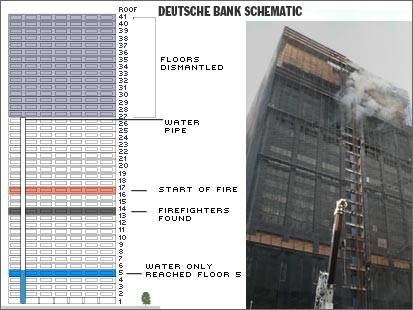
After visiting hundreds of sites around the city, the department has uncovered more than 120 violations since the Aug. 18 fire at the former Deutsche Bank building. The inspections have caused the city to shut down construction sites at a rate twice as high since the fire, compared with the months before, according to city records.

Some of the sites - close to 500 - are being inspected for the first time, despite city law requiring inspections every 15 days. The lapse in visits to the former Deutsche Bank tower failed to uncover a broken standpipe that supplies water to fire hoses, complicating firefighting efforts in the blaze that killed two firefighters.

Click on the link above for the rest of the story.

Monday, August 27

New York Fire Officers Reassigned After Fatal Blaze


Bloomberg.com: Worldwide
According to the Mayor "Inspections are not up for debate."
Three New York City Fire Department officers were stripped of their commands for failing to inspect and plan for a possible fire in the former Deutsche Bank building where an Aug. 18 blaze killed two firefighters, Mayor Michael Bloomberg said.

Deputy Chief Richard Fuerch, Battalion Chief John McDonald and Captain Peter Bosco of Engine Company 10, the firehouse closest to the building near the World Trade Center site in lower Manhattan, were transferred to headquarters, Bloomberg said at a City Hall press conference.

Investigators are trying to determine why Bosco's firehouse failed to inspect the building's water standpipe, which had been broken, every 15 days as law required. The probe will also explore why Fuerch failed to prepare a pre-fire plan for the building under demolition, Scoppetta said.

``These apparent failures in oversight, judgment and responsibility may require disciplinary action,'' Bloomberg said. The mayor said officials are cooperating with separate criminal probes by Manhattan District Attorney Robert Morgenthau and New York state Attorney General Andrew Cuomo.

The officers' reassignments will be temporary until the investigations into the fire are complete, the mayor said.

The fire started because demolition workers tossed lit cigarette butts on to the building's 17th floor, said Fire Commissioner Nicholas Scoppetta, who joined Bloomberg at the news conference. The city Fire Marshall ruled out electrical equipment or connections, he said.

``Cigarette smoking was rampant in the building and it was prohibited,'' said department spokesman Francis Gribbon.

Fire Investigation

The mayor said the investigation would seek to answer why the standpipe became inoperable, which left the burning building with no internal water supply, and why it hadn't been inspected, violating city regulations and the contract between the owner of the building, the Lower Manhattan Development Corp., and the demolition contractor, Bovis Lend Lease Co.

``The broken standpipe made it very difficult for firefighters to put water on the fire until they improvised and hoisted hose lines from the street, costing them valuable time,'' Bloomberg said.

Compounding the problem was the presence of plywood and polyurethane placed throughout the gutted building to contain asbestos and other toxic contaminants during the demolition process.

``High-rise fires almost always burn up, not down as this one did,'' the mayor said. ``We suspect that the effects of the negative air pressure system put in place as part of the containment operation pulled the fire down several floors quickly, putting the base of operations on the 14th floor at great risk.''

Failed to Act

Bloomberg said Bosco, captain of Engine Company 10, was reassigned because as commander of the firehouse closest to 130 Liberty Street, he should have ensured inspections of the standpipe were made every 15 days. McDonald, commander of Battalion 1, supervised Bosco.

Scoppetta said Fuerch, a division commander with more than 30 years experience in the department, had failed to act after Battalion Chief William Siegel in 2005 sent him several memoranda requesting that he draft a plan should a fire break out.

`Two Crimes'

John McDonnell, president of the Uniform Fire Officers Association, which represents the three officers, said the building was too hazardous to inspect every 15 days, requiring any firefighters to don protective suits and masks and go through time-consuming decontamination procedures.

``The real problem is that two crimes were committed in that building: someone who removed the standpipe so that water was unavailable, and the people who were smoking in that building,'' McDonald said in an interview. ``Both were criminal and neither fell under the fire department's purview.''

Pre-fire plans should be drafted whenever a demolition or construction site presents unique problems, Bloomberg said. This building, located near the World Trade Center and next door to Engine Company 10, ``where decontamination and demolition require equipment, that makes it a more dangerous situation,'' Bloomberg said.

Black Shroud

The building at 130 Liberty Street, shrouded in black mesh and filled with polyurethane and plywood to contain asbestos and other contaminants, has been vacant since Sept. 11, 2001, when the south tower of the World Trade Center collapsed near it.

The fire killed Robert Beddia, 53, of Staten Island, and Joseph Graffagnino, 33, of Brooklyn. The two worked out of the same firehouse, Engine 24-Ladder 5, that lost 11 firefighters on Sept. 11.

The mayor said the Fire Department's deputy chiefs would inspect all buildings that are under construction or being demolished to make sure of adherence to regulations ``regarding fire protection and public safety,'' the statement said.

``Structurally, we need to also put in place mechanisms to ensure that necessary fire inspections of buildings in our city take place as required,'' Bloomberg said. ``Inspections are not up for debate.''

Saturday, August 25

Firefighters Bid One of Their Own Farewell


Firefighters Bid One of Their Own Farewell - New York Times
RIP
The firefighters in crisp blue uniforms stood in formation for the second successive day, for the second funeral of a fallen comrade, a day after two more of their colleagues were injured at the same site where these two had perished.

There was grief today at St. Patrick’s Cathedral on Fifth Avenue, and even some laughter at a few memories of Firefighter Robert Beddia, a 23-year-veteran of the department who died on Saturday doing the work he loved.

The Rev. John Delendick, a fire department chaplain, told the mourners gathered at the ornate church that Mr. Beddia, 53, “didn’t become a firefighter for the money, he didn’t become a firefighter for the glamour.”

“He became a firefighter because of certain values,” the chaplain said.

But along with the grief there was weary frustration and simmering anger at the circumstances that had claimed Firefighter Beddia’s life.

He died on Saturday along with a colleague, Joseph Graffagnino, while battling a seven-alarm fire in the former Deutsche Bank building in Lower Manhattan, which was in the process of being dismantled. Both were assigned to Engine 24 and Ladder 5, based at a firehouse at Avenue of the Americas and West Houston Street in SoHo.

The fire raised troubling questions about why it had taken so long to bring down the 41-story building that was damaged beyond repair in the terrorist attacks on the World Trade Center in 2001.

On Thursday, as Firefighter Graffagnino’s funeral was taking place in Brooklyn, two more firefighters were injured at the building when a worker lost control of a small forklift on the 23rd floor of the building, sending it tumbling down 200 feet to the ground.

The forklift crashed through a construction shed on the ground level, and part of the shed collapsed on the two firefighters.

Both firefighters, Neil Nally, 35, and William Carbettis, 51, of Engine 258 in Long Island City, Queens, were listed in stable condition today at St. Vincent’s Hospital in Manhattan. They both sustained head injuries.

Firefighter Carbettis had his spleen removed. Firefighter Nally also had an injured back and right hand, according to a fire official, and could be allowed to leave the hospital today, fire officials said.

At today’s funeral for Firefighter Beddia, there were echoes of the funeral on Thursday for his colleague, Firefighter Graffagnino.

At both, bagpipers played “Amazing Grace” for a crowd of mourners that again included Gov. Eliot Spitzer, Mayor Michael R. Bloomberg and Fire Commissioner Nicholas Scoppetta.

And as a backdrop for both funerals, there were thoughts about the troubled building where all four fighters had been harmed, and about why city officials and building owners can’t seem to get to the bottom of the task of bringing down the condemned building.

Mayor Bloomberg, who said he had never met Firefighter Beddia, said he had been described to him by others as a dedicated professional.

“For 23 years he was a quiet hero,” the mayor said at the Mass. “He rarely spoke, but when he did others listened.”

The mayor also talked about the fire that took Firefighter Beddia’s life.

“This fires raised a lot of difficult questions,” the mayor said, adding that city and fire officials would “investigate to get to the bottom of what happened.”

Such an inquiry, he said, would hopefully “lead to actions to make the Fire Department stronger and safer.”

Firefighter Beddia often drove the fire truck for Engine 24, a post referred to as the chauffeur, but when he was not behind the wheel, he was working with the younger men, firefighters said.

Lt. Richie Quinn of the Fire Department spoke to reporters outside St. Patrick’s today about Firefighter Beddia.

“He was our chauffer, he knew every building inside and out, which was extremely helpful for us,” he said.

Firefighter Beddia’s sister, Susan Beddia Olson, spoke about him before his flag-draped coffin, in the form of a letter to him, which she began by saying, “Dear Bobby,” the name those close to him called him.

“Remember walking me down the aisle?” she asked. “Remember dancing with me at my wedding?

“You are my friend, you are my brother,” she said. “You are my hero.”

Two hours after the funeral mass had begun — as the family and other mourners accompanied the coffin out of the cathedral, from where it will be taken to a cemetery in Staten Island for burial — hundreds still lined Fifth Avenue.

A church bell tolled, and the crowd went silent as Firefighter Beddia was led out of Manhattan, a borough whose streets he knew so well, for the last time.

Wednesday, August 22

Subcontractor at WTC site dropped after fire


The abandoned Deutsche Bank building was filled with hazardous chemicals, holes in the floors and a maze of plastic sheeting that made it a virtual death trap for firefighters.

Yet the New York City Fire Department did not have a contingency plan for fighting a fire there, as is required for every building in the city, city and fire officials said Wednesday.

The building's central water pipe, which was disconnected on Saturday, the day of the fire, and is one of the factors being blamed for the deaths of two firefighters, also was not being inspected regularly as the law requires, city and fire officials said.

"Things didn't go right," Steve Cassidy, president of the Uniformed Firefighters Association said Tuesday. "In the end, we lost two firefighters in a toxic building that's about to be torn down. It's unacceptable that it happened."

Both Manhattan District Attorney Robert Morgenthau and state Attorney General Andrew Cuomo launched investigations into the fire this week.

Meanwhile, a controversial subcontractor in the project, the John Galt Corp., was let go Wednesday, days after it was revealed that both the city and federal governments had issued it numerous violations for problems including holes in the floor, falling debris and sparks flying near combustible material.

The Fire Department is still investigating how the deadly blaze started Saturday afternoon, city officials said Wednesday.

The firefighters killed, Joseph Graffagnino, 33, of Brooklyn, and Robert Beddia, 53, of Staten Island, will be buried Thursday and Friday, respectively.

Cassidy said for more than a year before the fire, local firefighters were not allowed into the building to do regular inspections because of the poor air quality there. He is asking who was doing the inspections, if not the local firehouse.

Fire Department spokesman Jim Long said the department is looking into why there was no pre-fire plan for the building and why the department was not inspecting the water pipe regularly.

However, even if the fire department was not doing regular inspections of the water pipe, the city building department was, city officials said. According to building department records, only the day before the fire, an inspection showed that the pipe was assembled properly and seemed to be working.

When it was taken apart -- part of the pipe was found lying on the floor after the fire -- remains a mystery, city officials said.

Work on deconstruction of the building was stopped immediately after the fire, and now that John Galt has been taken off the project, it isn't likely to resume soon.

In a letter to John Galt explaining why the company's contract is in default, James Abadie, the principal-in-charge of Bovis Lend Lease, the primary contractor, said: "The numerous citations issued with respect to employee safety and the failure to properly maintain all required site safety precautions are only some areas of concern."

Fire Dept. Did Not Inspect Pipe in Doomed Building


The New York Fire Department failed to visually inspect standpipes in the former Deutsche Bank building every 15 days as required by city rules for buildings being demolished, and had not done any inspections at the building since November 2006, according to records released yesterday by City Hall.

The standpipe system’s readiness to perform in a fire was last checked in November 1996, when the building was a functioning office building, and the system was filled with water and tested with pressure gauges, the Bloomberg administration said. Under fire codes, it is the building owner who must do such water, or hydrostatic, tests.

The Sept. 11 terrorist attack on the World Trade Center stymied plans for the next water test of the system at the Deutsche Bank building, at 130 Liberty Street, in November 2001, and no further testing of the system was required because the building, mortally damaged, was likely to be demolished.

Investigators have zeroed in on the building’s standpipe as they investigate last Saturday’s fire and exactly what led to the deaths of two firemen, Robert Beddia, 53, and Joseph Graffagnino, 33, who were battling it. The standpipe was not operational before the fire broke out, according to an administration news release.

A standpipe valve between the basement of the first floor of the building was shut, and the network of pipes that is supposed to deliver water from fire trucks in the street to the standpipe system’s connections was compromised, officials said. Also, a piece of the standpipe system was missing altogether and was found lying in the building’s basement.

A city official said it appeared that the twice-monthly standpipe inspections that are mandatory for buildings under demolition were never done. It is unclear whether the potential environmental dangers due to toxins in the building kept firefighters from making the inspections, the official said.

Investigators in the office of Manhattan district attorney Robert M. Morgenthau visited the basement of the building yesterday and took photos.

One fire investigator said that the law enforcement officials were struck by how damaged the standpipe was. The investigator also said it appeared that workers had been staying in the basement overnight, in violation of an order to keep people out.

The records released by City Hall — a possibly incomplete list based on “paper records” that the Bloomberg administration has so far reviewed — offered a sober assessment of the Fire Department’s oversight at the building.

They also show that the department was aware of reports that the sprinkler system was not working. That failure is also under investigation. Buildings Department inspectors visited the skyscraper to approve the dismantling of each floor, and determined that the standpipe had been properly capped on the floor below.

A fire official noted yesterday that firefighters were in the building for reasons other than inspections, once when a pipe fell from the building last spring and crashed into a nearby firehouse. Fire personnel were also in the building in August when citations were issued to the contractors, the officials said.

The records also detailed a series of violations that have been issued by the Buildings Department against Bovis Lend Lease, the contractor overseeing the entire demolition project, and the subcontractor in charge of the demolition, the John Galt Corporation.

Bovis was cited on June 6 for a “large amount of combustible material/debris” accumulating. The subcontractor was cited on Aug. 1 because “burning operations,” were causing sparks to fly; and on Aug. 3 for an expired certificate to “store/use acetylene.”

Investigators are focusing on a discarded cigarette or faulty electrical panel as the likely cause of the blaze.

The last time fire officials from Engine 10 — which is in the skyscraper’s shadow — did a “regular surveillance inspection,” in the building was March 31, 2006, the records show.

The Assembly speaker, Sheldon Silver, the State Legislature’s top Democrat, said he found the lack of recent water tests, “incredible. It’s amazing.”

“This is really a shock that even five years before Sept. 11, much less since Sept. 11, nobody checked that out,” said Mr. Silver, who represents residents of Lower Manhattan. “There are very serious concerns about that. The community has been overwhelmingly concerned about that building.”

The Buildings Department has conducted daily inspections of the floors under deconstruction since March 19, said Kate Lindquist, a department spokeswoman. The most recent inspection prior to the fire was the day before it broke out, she said, when an inspector confirmed that the standpipe was capped on the floor below deconstruction.

It is unclear when anyone from the Buildings or Fire Departments last inspected the standpipe system in the basement, where the broken pipe was found.

“That is one of the questions we are trying to answer,” said Ms. Lindquist. “We are reviewing our inspection reports.”

The law does not require the Buildings Department to conduct comprehensive testing of the standpipe system, she said. But a licensed site-safety manager is required to visually inspect the standpipe and its valves — to ensure they are connected properly — every day, the city official said.

Thursday, June 28

Home inspection nightmares


Home Inspection Nightmares IV

http://www.thisoldhouse.com/toh/gallery

Check out these pictures of disasters found by home inspectors. They will surprise you!!


The top photo shows some extreme whittling of a floor joist to accommodate a bathtub drain, along with telephone wire supporting drain pipes. The other picture is of a window in an addition...built against a brick wall...makes it kind of hard to escape! The rest of the photos are just as interesting!

Remember....these were all found in homes....where most fires occur! There are safety issues here for both the occupants AND the responders! What's in YOUR home?

Friday, March 30

Mine owner fined $1.5 million after probe of fatal fire


Mine owner fined $1.5 million after probe of fatal fire

Everything that could be wrong...was. Passive protection was missing, systems didn't work, parts were incompatible, training inadequate, incorrect escape plan and no water.

A report by the Mine Safety and Health Administration chronicled safety shortcuts and flagrant violations of basic mining laws at the company's Aracoma Alma No. 1 mine just outside this southern West Virginia town. Two miners died at Aracoma Alma on Jan. 19, 2006, when they became lost amid dense smoke that poured into what was supposed to be a sealed escape route, after a conveyor belt caught fire.

"At Aracoma, it appears that deficiencies were not fully recognized by mine personnel or by state or federal inspectors," the company statement said.

The MSHA investigation found widespread and serious failures in the Aracoma Alma operation, including a nearly half-hour delay in ordering miners in the area to evacuate when the air monitoring system sounded.

It also described a chaotic scene in which workers had no water to fight the fire, incompatible firehose couplings and inaccurate mine maps with which to attempt a rescue.

The two miners, both roofbolt operators, were part of a 12-man crew working three miles into the mine when the fire started. As the crew tried to make its way out, it found the escape path filled with smoke due to a missing stopping, a panel that directs airflow underground.

"That stopping never existed. It existed only on paper, on some maps," said Bill Francart, a Pittsburgh-based mining engineer who was part of the investigative team.

Friday, March 16

Fire Safety

Direct marketing? A new idea for Public Fire Education...

Wednesday, March 14

Omaha Fire Department To Crackdown On St. Patrick's Day Overcrowding


Fire Prevention Bureau To Conduct Special Fire Code Inspections

OMAHA, Neb. -- The Omaha Fire Department announced Wednesday that it will conduct a special evening-hours fire code inspection effort on Saturday.

According to a news release, the goal will be to work with business owners in order to ensure buildings are as fire safe as they can be.

"This is especially important during highly attended events held at public assemblies, such as the scheduled St. Patrick's Day celebrations combined with the NCAA Basketball tourney," according to the release.

The release states that inspections are not expected to disrupt normal business operations, but if a critical code violation or overcrowding situation is noted, a headcount may be conducted. Source: KETV.com